

Sea Shipping Costs China to USA are a huge concern for importers these days. If you’re shipping containers along this route, you’ll want to know exactly what you’re paying for—and why.
Container shipping from China to the USA is one of the world’s busiest trade lanes. Getting a grip on all the costs can save you thousands, not to mention a lot of stress and delays.
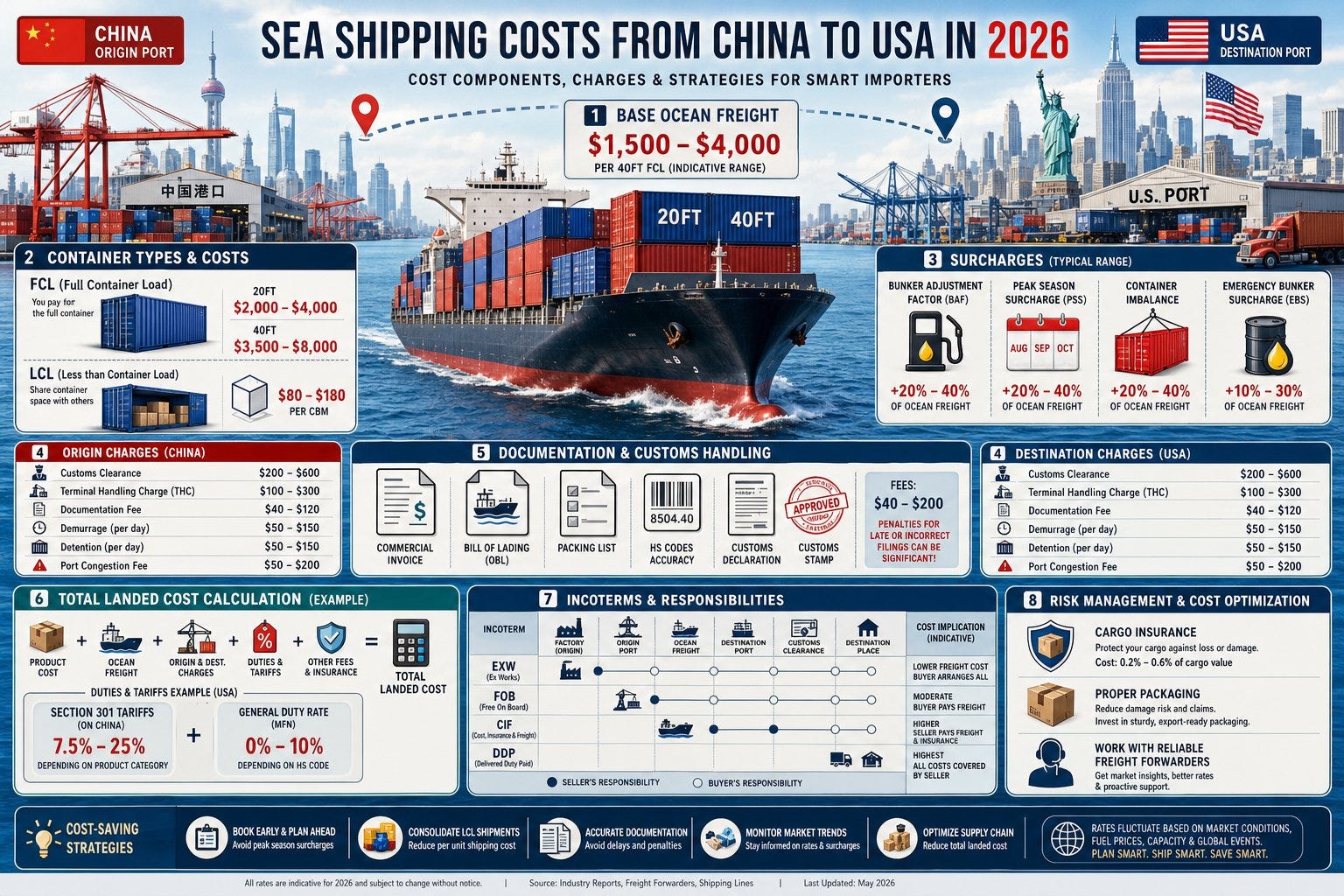
Sea freight from China to USA typically costs between $1,500 and $4,000 per container, with transit times ranging from 15 to 35 days depending on your chosen ports and shipping method. But that’s just the base rate—you’ll need to factor in extra fees, surcharges, and customs duties that can really add up.
Final prices depend on things like container type, volume, the season, and your service choices. Here’s a breakdown of Sea Shipping Costs China to USA so you can budget smarter and pick the most cost-effective option.
Contents hide
2 Breakdown of Core Sea Freight Costs
2.1 FCL Versus LCL: Cost Structures Explained
2.2 Understanding Base Ocean Freight and Carrier Surcharges
2.3 Origin and Destination Charges in Detail
3 Surcharges, Fees, and Additional Charges
3.1 Bunker Adjustment Factor, PSS, and Fuel Surcharges
3.2 Documentation and Customs Handling Fees
3.3 Demurrage, Detention, and Congestion Costs
4 Calculating Total Landed Cost
4.1 Chargeable Weight, Volumetric Weight, and Dimensional Weight
4.2 Sea Shipping Costs China to USA: Import Duty, Duty Rates, and Section 301 Impacts
4.3 Commercial Invoice, HS Code, and Packing List Essentials
5 Sea Freight Service Types and Incoterms
5.1 CIF, FOB, EXW, and DDP: Responsibilities and Cost Implications
5.2 How DDP Shipping Simplifies Final Delivery
5.3 Role of Documentation and Bills of Lading
6 Best Practices for Cost Efficiency and Risk Management
6.1 Cargo Insurance and Liability
6.2 Packaging, Palletization, and Cargo Handling
6.3 Working With Freight Forwarders to Secure Competitive Rates
7.1 What factors most affect the cost of ocean freight from China to the United States?
7.2 How are sea freight charges calculated (FCL vs LCL, CBM, and weight rules)?
7.3 What is the typical transit time for ocean freight from major Chinese ports to U.S. ports?
RELATED Sea Shipping Rates China to USA: Costs, Charges, and Key Factors
Key Takeaways
Container shipping costs shift based on freight type, surcharges, and seasonal demand spikes.
Your total landed cost means base freight rates plus customs duties, port fees, and delivery charges.
Choosing the right service type and shipping terms can cut costs and help you dodge delays.
RELATED Sea Shipping From China To USA: Complete Guide To Ocean Freight Services And Transit Times
Breakdown of Core Sea Freight Costs
When you’re shipping from China to the USA, your total cost includes base ocean freight, surcharges, and charges at both ends. The cost structure changes depending on whether you use a full container or share space.
FCL Versus LCL: Cost Structures Explained
Full container load (FCL) means you rent the whole container. Less than container load (LCL) means you share space and only pay for what you use.
For FCL shipping, the rate is flat per container, no matter how much you fill it. A 20-foot container usually runs $2,000 to $5,500. A 40-foot container can go from $3,500 to $8,000. That predictability makes FCL easier for budgeting.
LCL shipping charges by cubic meter, usually $80 to $180. It looks cheaper at first, but LCL adds consolidation and deconsolidation fees. FCL becomes more cost-efficient than LCL once your cargo exceeds 12 to 15 cubic meters.
LCL takes longer because your cargo gets mixed and sorted with others. FCL is faster, with less handling, and there’s less risk of damage.
Understanding Base Ocean Freight and Carrier Surcharges
Base ocean freight is the main port-to-port shipping fee. This rate goes up or down with demand, season, and route.
Carriers tack on several surcharges beyond base freight. The usual suspects include:
Bunker Adjustment Factor (BAF) – covers fuel swings
Peak Season Surcharge (PSS) – added during high-demand months, like August to October
Container Imbalance Surcharge – for when containers are hard to find
Emergency Bunker Surcharge (EBS) – for sudden fuel cost hikes
These surcharges can add 20% to 40% to your base rate. They change fast—sometimes monthly, sometimes even weekly. West Coast routes usually have lower base rates than East Coast, but your total depends on your final destination and inland haulage.
Origin and Destination Charges in Detail
Origin charges in China cover fees before your cargo boards the ship. You’ll pay for customs clearance, paperwork, and terminal handling charges (THC) at departure. These typically add $200 to $500 per container.
Destination charges in the USA are often higher and more complicated. Terminal handling fees at U.S. ports range from $400 to $800 per container. Customs clearance costs another $100 to $200, plus inspection fees if you’re picked.
Other destination charges can include:
Container Freight Station (CFS) fees for LCL shipments
Chassis rental for moving containers out of the port
Demurrage if you go over free storage time
Detention if you keep the container too long
These extras often catch new importers off guard, adding $800 to $1,500 per container to your total shipping cost from China to USA. Always ask for a complete door-to-door quote so you know your real landed cost.
RELATED Sea Shipping Quotes China to USA: Complete Cost & Process Guide
Surcharges, Fees, and Additional Charges
Even after the base ocean freight rate, you’ll face more surcharges and fees that can add hundreds per container to your total shipping costs. Fuel surcharges, paperwork, and penalties for delays can make up 20-30% of your landed cost.
Bunker Adjustment Factor, PSS, and Fuel Surcharges
Your carrier adds a Bunker Adjustment Factor (BAF) to cover fuel price swings. This charge updates monthly with global oil prices and low-sulfur fuel rules. You’ll see BAF as a separate line on your invoice, often $200 to $800 per container depending on route and market.
The Peak Season Surcharge (PSS) shows up in busy months, usually August to October. MSC hiked their PSS by $500 for 20-foot containers and $1,000 for 40-foot containers in late 2024. Other carriers do the same—peak season surcharges are pretty much the norm during the rush.
Port congestion surcharges hit when terminals back up. These temporary fees reached $1,000 per container during the 2021 Yantian mess, and you’ll still see them at crowded U.S. ports.
Documentation and Customs Handling Fees
You’ll pay documentation fees of $40 to $100 per shipment for bill of lading and export paperwork. Customs brokers usually charge $100 to $200 per shipment for filing entries and dealing with U.S. Customs.
The Importer Security Filing (ISF) needs to be in 24 hours before loading. Late or wrong ISF filings can mean penalties from $5,000 to $10,000 per violation. Most freight forwarders charge $25 to $50 for this service.
You’ll also need a customs bond to clear your goods. A single entry bond is about $50 to $100 and covers 110% of the duties owed. The Harbor Maintenance Fee adds 0.125% of your cargo’s value at U.S. ports.
Section 301 tariffs on Chinese goods tack on 7.5% to 25% to your product value, depending on the category. These show up as separate line items during clearance.
Demurrage, Detention, and Congestion Costs
Demurrage fees start when your container sits at the terminal past the free days, usually 3-7 days. Expect $75 to $150 per day after that. These can jump to $200 or more per day after two weeks.
Detention fees hit when you keep the carrier’s container and chassis too long after pickup. Daily rates start at $50 and rise the longer you hold the equipment. Planning your Sea Shipping Costs China to USA should include a strategy for quick container return.
Port congestion at Los Angeles and Long Beach can mean extra dwell fees. Seattle sometimes charges up to $150 per day if your container stays more than 5 days. You might be able to negotiate more free time, especially if you ship high volumes or face delays outside your control.
RELATED Sea Freight from China to USA: The Most Cost-Effective Shipping Method
Calculating Total Landed Cost
Landed cost covers your product price, ocean freight, customs duties, and every fee from the Chinese port to your U.S. warehouse. Knowing how weight and volume affect freight, how duty rates stack with Section 301 tariffs, and what paperwork you need helps you avoid nasty surprises.
Chargeable Weight, Volumetric Weight, and Dimensional Weight
Ocean carriers charge you based on whichever is higher: actual weight or volumetric weight. Volumetric weight is length × width × height (in cm) ÷ 6000 for ocean shipments. Bulky but light shipments pay for the space, not the weight.
Chargeable weight decides your final freight bill. If your cargo weighs 800 kg but its volumetric weight is 1,200 kg, you pay for 1,200 kg. This really matters for LCL shipments priced per cubic meter—expect $85 to $150 per cbm, depending on route and season.
FCL avoids this since you rent the whole container. A 40-foot container holds about 67 CBM, weight aside, so you pay one flat rate. It’s smart to calculate your cargo volume before picking LCL or FCL—don’t pay premium rates for empty air if you don’t have to.
Sea Shipping Costs China to USA: Import Duty, Duty Rates, and Section 301 Impacts
Sea Shipping Costs China to USA can get confusing fast, especially once you look at all the duty rates and tariffs. Your duty rate depends on your product’s HS code and the country of origin.
Base MFN (Most Favored Nation) rates range from 0% to 32%. Chinese imports face additional Section 301 tariffs of 7.5% to 25% on top of the base rate, which really adds up.
These tariffs stack together. For example, a product with 6% base duty and 25% Section 301 rate pays 31% total on the customs value.
Section 122 universal tariffs add another 10% through July 2026 for most products. Items subject to Section 232 metal tariffs are exempt, which is a small relief if you’re shipping those.
Import duty applies to the CIF value (cost + insurance + freight). If your product costs $10,000, insurance is $50, and freight is $500, duties are calculated on $10,550.
At a 25% rate, you’re looking at $2,637.50 in duties alone. Import costs from China also include a Merchandise Processing Fee of 0.3464% and a Harbor Maintenance Fee of 0.125% for ocean cargo.
Commercial Invoice, HS Code, and Packing List Essentials
Your commercial invoice must show the seller, buyer, detailed product description, unit price, total value, and payment terms. Customs uses this document to assess duties.
Undervaluing goods to reduce duties triggers penalties and shipment holds. It’s tempting, but not worth the risk.
The HS code (Harmonized System code) is a 6-10 digit classification that determines your duty rate. Using the wrong code costs you money or delays your shipment.
Verify your code with a customs broker or through the Harmonized Tariff Schedule. It’s a headache, but skipping this step can cause serious issues.
Your packing list details every carton’s contents, dimensions, and weight. It must match your commercial invoice exactly.
Customs compares these documents during clearance. Mismatches cause inspections, so include gross weight, net weight, and carton marks that match the physical labels on your boxes.
RELATED China to USA Shipping Cost: 2026 Rate Guide and Factors Affecting Freight Prices
Sea Freight Service Types and Incoterms
Sea Shipping Costs China to USA depend a lot on your service type and Incoterm. These choices decide who pays for shipping, who handles customs, and when risk transfers from seller to buyer.
Understanding terms like FOB, CIF, EXW, and DDP really helps you control costs and avoid surprises during transit.
CIF, FOB, EXW, and DDP: Responsibilities and Cost Implications
FOB (Free on Board) is the most common choice for importing from China. The supplier delivers the cargo to the port and handles export clearance.
You pay for ocean freight, insurance, and all costs after the goods leave the Chinese port. This gives you some control, but it does mean more work.
CIF (Cost, Insurance, and Freight) means the supplier pays for shipping and insurance to your destination port. You still handle import customs and final delivery.
This option gives you less control over carrier selection and insurance coverage, which can be a drawback if you want to manage every detail.
EXW (Ex Works) puts full responsibility on you from the factory door. You arrange pickup, export clearance, ocean freight, and import customs.
Hidden local charges in China often make this the most expensive option, even if it looks cheaper upfront.
Delivered Duty Paid (DDP) covers everything, including customs duties and final delivery to your address. The supplier manages the entire process, but you typically pay higher markups.
DDP shipping works best when you want simplicity over cost control. Sometimes, peace of mind is worth the extra dollars.
How DDP Shipping Simplifies Final Delivery
DDP shipping removes the burden of customs clearance and last-mile delivery from your plate. Your supplier handles import duties, taxes, and transportation to your warehouse or facility.
You receive a single price that includes all costs. This approach works well for smaller businesses without customs expertise.
You avoid dealing with customs brokers, duty calculations, or unexpected fees at the border. The trade-off is reduced visibility into actual shipping costs and potential markups on duties and freight charges.
DDP sea freight typically costs more per shipment than FOB but requires less effort. DDP air freight offers the same convenience for urgent shipments.
Most experienced importers prefer FOB for better control over freight rates and carrier selection, reserving DDP for occasional or test shipments.
Role of Documentation and Bills of Lading
The bill of lading serves as your receipt, shipping contract, and proof of ownership. Ocean carriers issue this document when cargo loads onto the vessel.
You need it to claim your goods at the destination port. Three main types exist: straight bill of lading (non-negotiable), order bill of lading (transferable), and seawaybill (fastest release).
Most shipments use order bills because they allow you to transfer ownership or arrange payment terms with buyers. Consolidation and deconsolidation require additional documentation for LCL shipments.
Your freight forwarder combines multiple shipments into one container, creating a master bill of lading for the container and individual house bills for each shipper. Documentation errors cause most customs delays, not actual shipping problems.
Ensure your commercial invoice, packing list, and bill of lading match exactly in product descriptions, quantities, and values. Double-checking here saves a lot of headaches later.
RELATED Sea Freight China USA: Complete Guide on Costs, Routes & Delivery
Best Practices for Cost Efficiency and Risk Management
Protecting your shipment and controlling costs demands attention to insurance coverage, proper cargo preparation, and the right logistics partners. These practices directly impact your total landed cost and help minimize the risk of financial loss during transit.
Cargo Insurance and Liability
Cargo insurance protects you from financial loss if your goods are damaged, lost, or stolen during transit. Standard carrier liability is limited and covers only a fraction of your cargo’s actual value.
Most carriers offer minimal coverage based on weight, not the actual value of your goods. This means a container worth $50,000 might only be covered for a few hundred dollars under basic carrier liability.
Marine cargo insurance fills this gap. It covers the full declared value of your shipment and protects against risks like rough seas, container damage, theft, and even port strikes.
Policies typically cost between 0.3% and 1% of your cargo value, making it affordable protection for most shipments. You should declare the full replacement value of your goods, including the product cost, freight charges, and duties.
Underinsuring to save on premiums can leave you with significant losses if something goes wrong. It’s just not worth the gamble.
Packaging, Palletization, and Cargo Handling
Proper packaging and palletization reduce damage and maximize container space. Poor packaging wastes money through damaged goods and inefficient use of carrier capacity.
Use sturdy corrugated boxes designed for ocean freight. Marine shipping exposes cargo to humidity, temperature changes, and rough handling during consolidation and deconsolidation.
Reinforce boxes with strapping and use moisture barriers when needed. Palletization improves handling efficiency and protects goods from damage.
Standard pallet sizes are 48″ x 40″ for the US market. Secure products to pallets with stretch wrap and corner protectors.
Key packaging considerations:
Use dunnage to prevent shifting inside containers
Label boxes clearly with handling instructions
Consider cargo weight distribution to prevent tipping
Stack pallets properly to maximize vertical space
Calculate your container utilization rate before shipping. Optimizing cargo volumes helps you decide between LCL and FCL options.
Poor space planning leads to paying for unused container capacity or unnecessary consolidation fees. Double-check your math before booking.
Working With Freight Forwarders to Secure Competitive Rates
Freight forwarders negotiate better rates than individual shippers because they consolidate volume across multiple clients. They also handle documentation, customs clearance, and coordination between carriers.
Choose forwarders with established relationships on China-USA routes. They secure preferential rates during peak seasons when carrier capacity becomes tight.
Ask about their volume commitments with specific carriers and whether they can guarantee space during high-demand periods. Request detailed quotes that break down all charges.
Base ocean freight is only part of your total cost. Look for line items like terminal handling, documentation fees, customs clearance, and inland delivery.
Hidden fees add up quickly. Compare multiple forwarders but focus on value, not just the lowest rate.
A cheaper quote might exclude essential services or come from a forwarder with poor customer service. Check their track record with cargo handling procedures and deconsolidation at destination ports.
Establish long-term relationships with reliable forwarders. Regular shippers often receive priority booking, better rates, and more flexible payment terms than one-time customers.
RELATED Container Shipping Rates China to USA: Costs, Ports, and Process
Frequently Asked Questions
Sea Shipping Costs China to USA can swing wildly. Ocean freight pricing depends on route density, container type, and mandatory government fees that add 15-30% to your base rate.
Understanding how carriers calculate charges and which ports minimize costs helps you avoid budget overruns. There’s no one-size-fits-all answer here.
What factors most affect the cost of ocean freight from China to the United States?
Your shipping route determines your base cost. West Coast ports like Los Angeles typically cost $1,200 to $2,500 for a 20ft container, while East Coast destinations range from $2,500 to $4,000 for the same container size.
Seasonal demand drives prices higher during peak months. Carriers add peak season surcharges between August and November when import volumes increase.
You’ll also face General Rate Increases that carriers implement twice monthly to adjust for capacity. Container availability affects your final cost.
When equipment is scarce at Chinese ports, carriers charge premium rates to secure space on vessels. Plan ahead to avoid these spikes.
How are sea freight charges calculated (FCL vs LCL, CBM, and weight rules)?
FCL shipping charges a flat rate per container regardless of how much space you use inside. You pay the same price whether your 40ft container is 50% full or completely loaded.
LCL shipments bill by cubic meter (CBM). If your cargo exceeds 13-15 CBM, booking a dedicated container becomes cheaper than paying per-CBM rates.
Your forwarder calculates CBM by multiplying length × width × height in meters. Weight becomes the billing factor only when cargo is exceptionally heavy relative to its volume.
Carriers apply a weight-to-volume ratio, and you pay whichever measurement is higher. Not sure which applies? Ask your forwarder—they’ll know.
What is the typical transit time for ocean freight from major Chinese ports to U.S. ports?
Shanghai to Los Angeles takes 12-16 days on direct sailings. This route offers the fastest ocean transit because it’s the busiest transpacific lane with multiple weekly departures.
Shenzhen to New York requires 25-35 days when routed through the Panama Canal. East Coast destinations always take longer due to the additional ocean distance.
Port congestion adds unpredictable delays. Your container might sit at anchorage for 3-7 days before berthing during peak periods.
Factor in extra time for customs clearance and final delivery after the vessel arrives. Patience is definitely required.
Sea Shipping Costs China to USA: Which origin and destination ports usually offer the lowest total landed shipping cost?
Sea Shipping Costs China to USA can swing a lot depending on your chosen ports. Shenzhen and Shanghai usually give you the best origin pricing.
These Chinese ports move the most containers, so carriers fight hard for business. That means more competition and way more frequent sailings.
On the U.S. side, Los Angeles and Long Beach almost always deliver the lowest total landed cost for most importers. Sure, ocean freight rates are pretty similar across the West Coast, but LA/Long Beach stands out for a reason.
You’ve got more carrier options there, plus inland trucking costs are usually lower. That adds up fast, especially if you’re moving a lot of containers.
Houston sometimes makes sense if you’re distributing to the Midwest or South. The Gulf Coast route might cost a bit more for shipping, but you could save on domestic rail and trucking to central U.S. warehouses. It’s not for everyone, but it’s worth a look if your supply chain points that way.
What additional fees should be expected beyond the base ocean freight rate (THC, documentation, and customs, and delivery)?
Terminal Handling Charges at the destination port usually add $200-$400 per container. If you’re shipping into U.S. West Coast ports, expect extra fees like PierPass and Clean Truck Fund charges—those will definitely bump up your terminal costs.
U.S. Customs tacks on a Merchandise Processing Fee of 0.3464% and a Harbor Maintenance Fee of 0.125% based on your cargo value. These government fees hit every commercial shipment, no exceptions.
You’ll pay $100-$200 per shipment for documentation and customs clearance. Don’t forget the customs bond; it runs $50-$500, depending on whether you go single-entry or continuous coverage.
Inland delivery from port to warehouse is another big variable. Drayage within 50 miles of the port might cost $150-$400 per container, but if you need cross-country trucking, that can easily top $3,000.
Sea Shipping Costs China to USA: How do Incoterms like FOB, CIF, and DDP change who pays for shipping and import costs?
Sea Shipping Costs China to USA can get confusing fast, especially with all those Incoterms floating around. Let’s break down how FOB, CIF, and DDP actually affect who pays for what.
FOB (Free On Board) means your supplier handles things only up to the point when your cargo gets loaded onto the ship. After that, you’re on the hook for ocean freight, insurance, U.S. customs duties, and getting the goods delivered once they arrive.
This setup gives you full control over which carrier to use and what route to take. However, it also puts more responsibility—and risk—on your plate.
CIF (Cost, Insurance, and Freight) shifts a bit more work to your supplier. They cover ocean freight and insurance to the U.S. port, but you’ll still need to manage customs clearance, pay duties, and arrange for inland transportation.
With CIF, your supplier picks the carrier, which can be a blessing or a curse depending on their choices. You get some peace of mind about shipping, but not total control.
DDP (Delivered Duty Paid) pretty much flips the script. Your supplier pays everything: ocean freight, customs duties, insurance, and even delivery to your door.
This option makes budgeting easier, no question, but it usually costs 10-20% more than FOB. Sometimes, paying extra for convenience feels worth it—sometimes not so much.
Related Posts
Sea Shipping Rates China to USA: Costs, Charges, and Key Factors
Sea Shipping From China To USA: Complete Guide To Ocean Freight Services And Transit Times
Sea Shipping Quotes China to USA: Complete Cost & Process Guide
Sea Freight from China to USA: The Most Cost-Effective Shipping Method
China to USA Shipping Cost: 2026 Rate Guide and Factors Affecting Freight Prices