

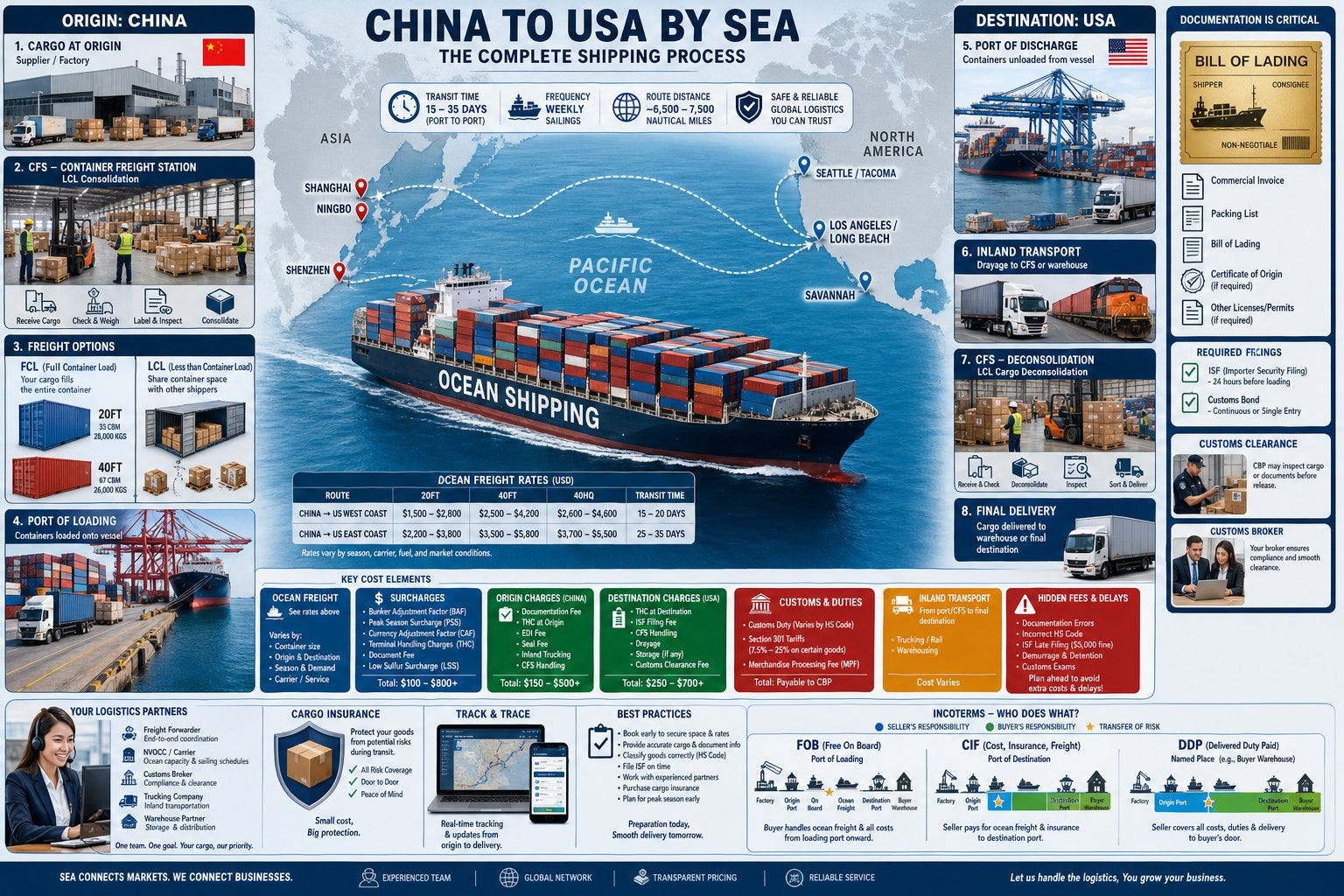
Shipping From China to USA by Sea is a huge part of global trade. Every year, American businesses import massive amounts of goods from China—think electronics, furniture, and more—all making their way across the Pacific in giant containers.
Sea freight from China to USA usually costs somewhere between $1,500 and $4,000 per container. Transit times range from 15 to 35 days, depending on your ports and shipping method.
Understanding how ocean shipping works can actually save you money and help you dodge frustrating delays.
The shipping process from China to the USA involves more than just tossing a container onto a ship. You have to think about freight options, customs requirements, port fees, and delivery methods.
Hidden costs and surprise delays? They happen a lot when folks don’t really get the shipping process.
This guide covers everything you need to know about sea shipping from China to USA. We’ll go over container options, cost breakdowns, customs clearance steps, and how to pick the right partners for your shipments.
Whether you run a small business or handle big imports, these insights should help you ship smarter—and hopefully with less stress.
Contents hide
2 Sea Freight Methods for China-USA Shipments
2.1 Full Container Load (FCL) vs. Less Than Container Load (LCL)
2.2 Choosing the Right Mode for Your Goods
2.3 Understanding Container Freight Stations
3 Cost Structure and Fees in Ocean Freight
3.1 Ocean Freight Rates and Surcharges
3.3 Peak Season and Congestion-Related Charges
3.4 Estimating Total Shipping Expenses
4 Essential Shipping Terms and Incoterms
4.1 FOB, CIF, and DDP Explained
4.2 Shipping From China to USA by Sea: Using Incoterms to Define Responsibilities
4.3 Bill of Lading and Shipping Documentation
5 Customs Clearance and Compliance for US Imports
5.1 US Customs Clearance Procedures
5.2 ISF Filing and Required Entry Bonds
5.3 Understanding Import Duties and Section 301 Tariffs
6 Role of Freight Forwarders and Logistics Partners
6.1 Selecting a Reliable Freight Forwarder
6.2 Coordination and Documentation Support
6.3 Warehousing and Bonded Storage Options
7 Cargo Insurance and Risk Mitigation
7.1 Freight Insurance Coverage Options
7.2 Managing Loss or Damage When Shipping From China to USA by Sea
8 Port Operations and Final Delivery
8.1 Port Handling and Processing
8.2 Final Mile Transport and Delivery Networks
10.1 What factors most affect ocean freight rates between Chinese ports and U.S. ports?
10.4 What is the cheapest way to ship goods by ocean, and when does LCL vs. FCL make more sense?
10.5 What documents are required for U.S. customs clearance when importing goods by sea from China?
RELATED Sea Shipping From China To USA: Complete Guide To Ocean Freight Services And Transit Times
Key Takeaways
Shipping From China to USA by Sea is usually the cheapest way to move large volumes.
Knowing your container types, customs steps, and freight terms can help you skip delays and hidden fees.
Working with experienced freight forwarders and getting proper insurance protects your cargo and makes shipping less of a headache.
RELATED Essential Guide to Shipping from China to USA: Optimize Your Logistics
Sea Freight Methods for China-USA Shipments
When shipping from China to USA by sea, you’ve got two main choices: FCL (full container load) or LCL (less than container load).
FCL gives you the whole container to yourself, while LCL means you share space (and costs) with other shippers. Your choice affects price, timing, and how your cargo is handled.
Full Container Load (FCL) vs. Less Than Container Load (LCL)
FCL shipping means you rent the entire container. Standard sizes? 20-foot (20GP) and 40-foot (40GP or 40HQ). You pay a flat rate—doesn’t matter how full it is.
FCL is best when you’ve got enough cargo to fill at least half a container. Ocean freight rates for a 40-foot container to the West Coast usually fall between $3,500 and $5,000. East Coast routes cost more—$4,500 to $6,500.
LCL lets you ship smaller loads by sharing container space. You pay based on how much space (in CBM) your stuff takes up. LCL rates are typically $40 to $80 per CBM.
LCL makes sense for shipments under 10-15 cubic meters. If you’re shipping more than that, FCL usually saves you money. Just know that LCL adds 5-7 days to your transit time—consolidation and deconsolidation take extra time.
Choosing the Right Mode for Your Goods
Your shipment’s size really decides whether FCL or LCL is better. To figure out your cubic meters, just multiply the length, width, and height of all your cartons (in meters).
Pick FCL if:
Your shipment is over 15 cubic meters
You want faster transit
Your goods are fragile or high-value
You want to avoid extra handling
Pick LCL if:
Your shipment is under 10 cubic meters
You’re testing new products or placing smaller orders
You need to keep upfront costs low
You ship smaller batches often
Weight and dimensions matter too. Heavy machinery or oversized items often need FCL, even if you don’t fill the whole container, since they can’t mix with other shipments easily.
Understanding Container Freight Stations
Container freight stations (CFS) are warehouses where LCL cargo gets grouped together before shipping or separated after arrival. Your goods pass through two CFS locations during port-to-port transit from China to USA.
At the origin CFS in China, workers combine your cartons with other shippers’ cargo. The full container travels by sea to a US port, then gets trucked to a destination CFS where workers sort everything out.
CFS handling adds fees—usually $50 to $150 per shipment at each end. They charge for receiving, storage, and loading/unloading. You usually get 3-5 free days to pick up your cargo before storage fees start stacking up.
FCL shipments skip CFS entirely. Your container goes straight from your supplier’s dock to the port, then from the US port to your delivery address.
RELATED Shipping From China To The USA: Essential Guide For Import Logistics And Costs
Cost Structure and Fees in Ocean Freight
Shipping From China to USA by Sea isn’t just about that base shipping rate—it comes with lots of extra charges. Your total cost includes surcharges, terminal fees, and seasonal price bumps that can add 30-50% to what you thought was the price.
Ocean Freight Rates and Surcharges
Current container shipping rates from China to the US are hovering around $2,127 per 40-foot container to the West Coast, and $3,069 to the East Coast (late 2025). But those base rates don’t tell the whole story.
Common surcharges you’ll see:
Bunker Adjustment Factor (BAF): A fuel surcharge that changes with oil prices
Peak Season Surcharge (PSS): Added during busy times
Currency Adjustment Factor (CAF): Deals with exchange rate changes
Terminal Handling Charges (THC): Pays for cargo handling at ports
These surcharges show up on almost every shipment. Carriers tweak them every month or quarter, depending on the market.
Landed Cost Components
Your landed cost is everything from the factory door to your final destination. It’s the real cost of your product—including all the little fees that sneak up on you.
Understanding shipping costs from China to the US means looking at all the fee categories. Port charges cover unloading, storage during free time, and equipment use. Customs fees include broker services, paperwork, and sometimes inspections.
Extra charges depend on your Incoterm. FOB puts more on you, DDP means the seller covers everything through delivery. Import duties and taxes are based on your product and aren’t in your freight quote.
Peak Season and Congestion-Related Charges
Peak season surcharges usually kick in from August through October, when retailers are stocking up for the holidays. Expect rate hikes of $500-$1,500 per container during these months.
Port congestion causes more delays and fees. If terminals are full, you might pay storage charges after your free days run out. Most ports give you 3-5 days of free storage.
Longer transit times from congestion mean you need to order inventory earlier. Red Sea diversions and other routing changes can add 1-2 weeks to your schedule, so it’s smart to plan ahead.
Estimating Total Shipping Expenses
Container shipping cost calculators give you a ballpark, but your real costs depend on your specific shipment. A 40-foot container usually costs just 20-25% more than a 20-foot one, so you get a better deal per cubic meter with the bigger size.
Here’s a rough breakdown of your total expense:
Always ask for detailed quotes that list every fee—don’t settle for a vague estimate. Compare a few freight forwarders, since their rates can vary a lot. Your shipment’s weight, volume, and delivery timeline all affect which option is best for you.
RELATED Ship from China to USA: Complete Guide to Methods, Costs & Customs
Essential Shipping Terms and Incoterms
Shipping From China to USA by Sea comes with its own language—Incoterms and shipping terms. Knowing these helps you keep costs under control and avoid confusion. The right Incoterm spells out who pays for what and when, while the right paperwork keeps your shipment moving through customs.
FOB, CIF, and DDP Explained
FOB (Free on Board) means the seller gets your goods to the port and loads them onto your ship. You take over costs and risks the moment it’s on board. This gives you more control and can save you money.
CIF (Cost, Insurance, and Freight) means the seller pays for shipping and insurance to your destination port. The vendor pays for insurance and shipping, which is easier for you, but costs more. You still handle import duties and customs clearance when it arrives.
DDP (Delivered Duty Paid) puts everything on the seller until your goods show up at your door. The seller handles shipping, insurance, customs, duties, and taxes. It’s more expensive, but you don’t have to worry about the details.
Shipping From China to USA by Sea: Using Incoterms to Define Responsibilities
Shipping From China to USA by Sea isn’t just about moving boxes across the ocean. Incoterms set the rules for who’s responsible at every step, making sure everyone knows where costs and risks change hands.
They help you avoid those awkward disputes by clearly marking the transfer points between you and your supplier.
FOB and Ex-Works are the most commonly used and recommended Incoterms for importing from China. With FOB, you get more pricing clarity and can pick your own carrier.
Your supplier loads the vessel, then you take over—handling ocean freight and everything that happens after the ship leaves.
The International Chamber of Commerce publishes Incoterms 2020, and there are 11 terms in total. Choose your Incoterm based on how much control you want and your experience with shipping from China to USA by sea.
If you’re new, CIF or DDP usually feels less stressful. More seasoned importers often go with FOB to save money and have more say in the process.
Bill of Lading and Shipping Documentation
The bill of lading is your golden ticket—receipt, contract, and proof of ownership all in one. Your carrier hands it over once the goods are loaded, and you’ll need it to claim your cargo at the destination port.
There are three types: straight bills (for a named consignee), order bills (transferable), and sea waybills (for quick releases, no originals needed). Ocean carriers usually issue three original bills.
Your bill of lading lists all the important stuff: shipper and consignee, vessel name, ports, container numbers, cargo description, weight, and charges. Guard this document—if you lose it, you can’t get your goods.
On top of that, you’ll need a commercial invoice, packing list, and import declaration for customs clearance.
RELATED Sea Freight from China to USA: The Most Cost-Effective Shipping Method
Customs Clearance and Compliance for US Imports
Shipping From China to USA by Sea means you have to deal with customs clearance, file the right documents (like the ISF), and pay any import duties—sometimes including Section 301 tariffs on certain goods.
US Customs Clearance Procedures
Customs clearance from China to the USA requires you (or your broker) to submit your shipment info to US Customs and Border Protection (CBP). You have 15 days from your cargo’s arrival at a US port to get those entry documents in.
The process starts with port filing in the US, sending all the paperwork CBP wants. They’ll check your shipment for compliance with US laws and regulations.
Be accurate with your product info—value, classification, country of origin. CBP can physically inspect your cargo or just review your documents.
Messy paperwork leads to delays, extra fees, or even shipment rejection. Most importers work with a licensed customs broker who handles everything and talks to CBP for you.
These brokers know the rules and help you dodge common mistakes.
ISF Filing and Required Entry Bonds
You need to file an Importer Security Filing (ISF) at least 24 hours before your cargo gets loaded in China. This only applies to ocean freight and needs 10 pieces of shipment data.
The ISF asks for things like:
Seller and buyer details
Manufacturer name and address
Ship-to party info
Container stuffing location
Commodity HTSUS numbers
If you miss the ISF deadline, you could get hit with a $5,000 penalty for each violation. You can file yourself or have your forwarder or broker do it.
To import into the US, you’ll also need a customs bond. Single entry bonds cover one shipment and usually cost $100 to $200. Import regularly? An annual bond runs $400 to $500 and covers all your shipments for a year.
Understanding Import Duties and Section 301 Tariffs
Your import duties depend on your product’s code in the Harmonized Tariff Schedule (HTS). The standard rates run from 0% up to 37.5% of your shipment’s value.
Section 301 tariffs add extra duties to certain Chinese products. These tariffs, set in several lists, now cover thousands of categories. Your goods might get hit with another 7.5% to 25% tariff on top of the regular duty.
Add up your product cost, shipping, insurance, standard duties, and Section 301 tariffs to get your total landed cost. For example, importing $10,000 worth of goods with a 5% duty and 25% Section 301 tariff means $500 in duties and $2,500 in tariffs.
Always check your product’s HTS code to see what applies. Some goods qualify for duty exemptions or exclusions from Section 301 tariffs, but you’ll need to apply for those with the US Trade Representative.
RELATED Shipping from China to United States: Complete 2026 Guide
Role of Freight Forwarders and Logistics Partners
Freight forwarders make shipping from China to USA by sea much less overwhelming. They coordinate your cargo’s journey, manage paperwork, book space, and handle customs clearance.
They’ll handle filings and offer warehouse options, smoothing out the bumps in the process.
Selecting a Reliable Freight Forwarder
Your choice of freight forwarder matters—a lot. Pick one with established offices in China and the US, so they can solve issues at both ends.
A reliable freight forwarder handles paperwork, negotiates rates, and gives you transport options. If you ship often, check if they offer weekly sailings on your routes.
Experience with your product type is important—especially if your goods need FDA, USDA, or other agency approval. Ask for references from similar clients and dig into their ISF filing accuracy, customs speed, and how they handle delays.
Forwarders who give you real-time tracking and solid communication make it easier to manage inventory and surprises.
Get quotes that break down all the costs—ocean freight, terminal fees, documentation, and delivery. Watch for hidden fees at the destination and ask for details upfront.
Coordination and Documentation Support
Freight forwarders act as logistics coordinators between you and the transport companies, handling the admin work that international shipping demands.
They prep and submit your ISF filing before vessel departure and coordinate AMS filings. Your forwarder arranges factory pickup, books container or LCL space, and checks that all export documents meet Chinese customs rules.
They make sure invoices, packing lists, and bills of lading match up—avoiding customs holds. At a container freight station, they consolidate LCL shipments and handle deconsolidation at the US port.
They’ll keep tabs on VGM submission, track deadlines, and monitor vessel schedules so your cargo doesn’t get rolled. When your shipment lands, they work with brokers to classify products and calculate duties, speeding up clearance.
Warehousing and Bonded Storage Options
Many forwarders offer bonded warehouse storage. You can keep your goods there before paying duties, which helps manage cash flow for large imports or slow-moving inventory.
Bonded warehouses let you defer duty payment until goods leave. You can repackage, relabel, or sort products there without owing duties right away.
This is handy for testing markets or handling seasonal surges. Some forwarders also provide regular warehousing for quick distribution to Amazon FBA or retail.
They’ll unload containers, palletize, and coordinate last-mile delivery. Storage fees usually depend on pallet count or space used per day.
Ask about warehouse locations near big ports like Los Angeles, Long Beach, or Savannah. Being close to your port cuts drayage costs and speeds up delivery.
RELATED Shipping from China to US: Costs, Methods, and Customs Explained
Cargo Insurance and Risk Mitigation
Shipping From China to USA by Sea comes with risks—think theft, damage, or loss during those 15-30 days at sea. Standard carrier liability is pretty limited: $30 per kilogram for air freight, and often under 5% of cargo value for ocean shipments.
Freight Insurance Coverage Options
You’ve got three main cargo insurance types for shipments from China.
ICC (A) gives you the broadest “all risks” protection, covering loss or damage from almost any cause—water, theft, contamination, you name it.
And ICC (B) only covers specific perils like fire or vessel stranding, but skips theft and freshwater damage.
ICC (C) is the bare minimum, for major events like explosions or groundings.
Most importers go for ICC (A) at CIF value plus 10%. That’s your invoice, freight, insurance, and a little buffer for profit. For a $100,000 shipment and $5,000 freight, you’d insure for $116,050.
Premium rates usually fall in these ranges:
Low-risk cargo (steel, lumber): 0.05-0.15% of insured value
Medium-risk (machinery, textiles): 0.15-0.35%
High-risk (electronics): 0.35-0.75%
Very high-risk (jewelry): 0.75-2.0%
Want to save on premiums? Use solid packaging, approved carriers, and GPS tracking for high-value shipments. That can trim costs by 10-20%—not bad for a little extra peace of mind.
Managing Loss or Damage When Shipping From China to USA by Sea
Shipping From China to USA by Sea can get complicated if you run into loss or damage. Report any loss or damage as soon as you find it to protect your claim rights.
Take clear photos of every damaged item and the packaging before you touch anything. Hang on to the original packaging materials—they’re your evidence for the surveyor’s inspection.
To start your freight insurance claim process, you’ll need the original policy, commercial invoice, packing list, bill of lading, and a damage survey report. Most insurers want notification within 72 hours for visible damage and within 30 days for hidden issues.
If you toss out damaged packaging too early, or mix damaged goods with undamaged stock, your claim can get delayed. Document everything with time-stamped photos, including container and seal numbers, plus the visible damage.
If your claim is over $10,000, ask for an independent surveyor inspection to get solid documentation of the loss.
RELATED Shipping Freight From China to the USA: Essential Guide for Import Businesses
Port Operations and Final Delivery
Shipping From China to USA by Sea doesn’t end when your container lands at a U.S. port. The container needs to clear terminal handling, customs, and ground transport before it gets to your warehouse or distribution center.
Port handling and discharge operations can tack on extra days, especially if terminals are crowded or if there’s a customs exam or chassis shortage.
Port Handling and Processing
Your container moves through a few steps at the port terminal before you can arrange pickup. First, the vessel unloads the container and places it in the terminal yard.
Terminal operators process your container in their system and update its status for customs review. Port charges include terminal handling fees for container discharge, yard storage, and gate operations.
If your container sits too long at the terminal, you’ll get hit with demurrage charges—usually after three to five days of free time. Detention charges show up if you keep the chassis too long after pickup.
Container availability depends on customs clearance, required inspections, and the terminal’s release process. If customs flags your shipment, you’ll pay extra for exams and extra handling time.
Your customs broker files entry documents and works with the terminal to get release authorization before you can move your container.
Final Mile Transport and Delivery Networks
After terminal release, you need to set up trucking or rail to your final stop. If you’re close to the port, direct trucking is usually fastest.
For inland locations, on-dock rail shipping can move your container straight from the port to an inland rail hub. Drayage trucking handles the trip from port to your warehouse, transload facility, or rail terminal.
Book delivery appointments with your receiving site—especially for Amazon FBA, which has strict windows and labeling rules. Final delivery costs change based on distance, fuel, chassis fees, and any special needs like liftgate or inside delivery.
RELATED Sea Shipping From China To USA: Complete Guide To Ocean Freight Services And Transit Times
About AEB Logistics
AEB Logistics specializes in Shipping From China to USA by Sea. Alan Fan leads the company, bringing over 20 years of experience as a global carrier executive.
AEB Logistics is a member of the Amazon Service Provider Network. If you need to ship to Amazon FBA, they offer specialized services.
The company gives you several shipping options:
Air freight for fast delivery
Ocean freight (FCL and LCL)
Door-to-door delivery
Customs brokerage and clearance
Warehousing and distribution
Container drayage and trucking
You’ll get a dedicated account manager who helps with paperwork, tracking, and delivery details.
The company offers free shipping quotes and transparent pricing. You won’t get stuck with hidden fees or surprise surcharges. AEB Logistics offers detailed charge breakdowns if you ask.
Track your shipments live with real-time updates. Their team handles most paperwork, including export licenses and customs bonds.
AEB Logistics serves businesses of all sizes. They focus on making international shipping straightforward and reliable for your supply chain.
RELATED Essential Guide to Shipping from China to USA: Optimize Your Logistics
Frequently Asked Questions
Shipping From China to USA by Sea involves several cost factors. Ocean freight rates change with fuel prices, seasonal demand, port congestion, and carrier capacity.
Total shipping costs include origin charges, ocean freight, destination fees, and customs expenses. Transit times usually run 14-20 days to West Coast ports and 28-38 days to the East Coast. You’ll need documents like commercial invoices, bills of lading, ISF filings, and customs bonds.
What factors most affect ocean freight rates between Chinese ports and U.S. ports?
Fuel costs play a big role in ocean freight rates, thanks to bunker adjustment factors. When oil prices climb, carriers add surcharges that bump up your bill.
Seasonal demand can send rates up and down. You’ll see higher prices during peak times, like August through October, when importers rush to stock up for holidays.
Port congestion at major terminals pushes container freight costs higher. If vessels wait at anchor, carriers pass those delays to you with congestion surcharges.
Carrier capacity and vessel space also affect your rates. When ships are full, carriers charge more since space is limited.
How is the total sea freight cost calculated, including origin, destination, and port-related fees?
Your total sea freight cost starts with origin charges in China, like container pickup, export customs clearance, and terminal handling fees. These usually run $150 to $400, depending on your supplier and port.
Ocean freight makes up the main cost, based on container size and route. A 40-foot container to the West Coast costs $3,500 to $5,000, while East Coast shipments run $4,500 to $6,500.
Destination charges add more once your container lands in the U.S. You’ll pay for port handling, chassis fees, unloading, and customs clearance—often $800 to $1,500 per container.
Extra fees include documentation, ISF filing ($50 to $100), and customs bonds. Special services like inspection or storage beyond the free period cost more.
How long does ocean transit typically take from major Chinese ports to the U.S. West Coast and East Coast?
West Coast ports get containers fastest because of the shorter Pacific route. Standard transit from Shanghai or Shenzhen to L.A. or Long Beach takes 14 to 20 days.
Expedited services can cut West Coast transit to 11 to 14 days. They cost more, but sometimes you just need things faster.
East Coast shipping from China to USA takes much longer—usually 28 to 38 days. Your container crosses the Pacific, goes through the Panama Canal, then up the Atlantic to ports like New York or Savannah.
Transit times shift based on carrier, vessel speed, stops, and weather. Add 3 to 7 days for customs clearance and final delivery after docking.
What is the cheapest way to ship goods by ocean, and when does LCL vs. FCL make more sense?
LCL shipping is smart if your cargo fills less than half a container. You share space and only pay for what you use, usually per cubic meter or weight.
FCL gets more cost-effective when your shipment hits 15 cubic meters or more. You pay a flat rate for the whole container, which lowers per-unit costs for bigger loads.
Standard ocean freight to West Coast ports is usually the cheapest shipping option compared to air or express. Your final cost depends on the last-mile delivery, since trucking from the port adds up.
It’s cheaper to use the entry port closest to your warehouse. Shipping directly to the East Coast saves money versus landing on the West Coast and trucking everything east.
What documents are required for U.S. customs clearance when importing goods by sea from China?
Your commercial invoice needs to show value, description, quantity, and country of origin. Customs uses this to figure out duties and check your shipment.
The bill of lading is your receipt and contract with the carrier. You’ll need the original or a telex release to pick up your container at the port.
ISF filing goes to U.S. Customs 24 hours before the vessel leaves China. This Importer Security Filing lists 10 shipment details and your supplier’s info.
You need a customs bond for all commercial imports. You can get a single-entry bond for one shipment or a continuous bond for all imports over a year.
Other documents include a packing list, certificates of origin for duty preferences, and special certifications depending on your goods. Shipping cargo from China to USA means strict documentation—otherwise, customs delays can get ugly.
What are the most common import duties, taxes, and customs fees U.S. importers should expect on ocean shipments?
Shipping From China to USA by Sea comes with a set of import duties and taxes you just can’t ignore. The exact amount depends on your product’s classification under the Harmonized Tariff Schedule.
Your HTS code decides the duty rate. Some items get a 0% rate, but others—think clothing or footwear—can shoot up past 30%.
Section 301 tariffs also hit many Chinese goods. These extra tariffs usually range from 7.5% to 25%, based on the product list your shipment falls under.
These added tariffs can really bump up your landed costs. It’s something that surprises a lot of new importers.
Merchandise Processing Fee comes in at 0.3464% of your shipment’s value. There’s a minimum of $27.75 and a max cap at $538.40 per entry.
This fee helps cover customs processing. It applies no matter what you’re shipping.
Harbor Maintenance Fee adds another 0.125% of your cargo’s value. This fee keeps port infrastructure running and applies to all commercial cargo entering U.S. seaports.
Most importers also pay customs broker fees. These usually run between $100 and $200 for each entry.
Customs brokers help you handle clearance and all those tricky regulations. It’s not a government charge, but honestly, most people find it worth the cost.
Related Posts
Sea Shipping From China To USA: Complete Guide To Ocean Freight Services And Transit Times
Essential Guide to Shipping from China to USA: Optimize Your Logistics
Shipping From China To The USA: Essential Guide For Import Logistics And Costs
Ship from China to USA: Complete Guide to Methods, Costs & Customs
Sea Freight from China to USA: The Most Cost-Effective Shipping Method