

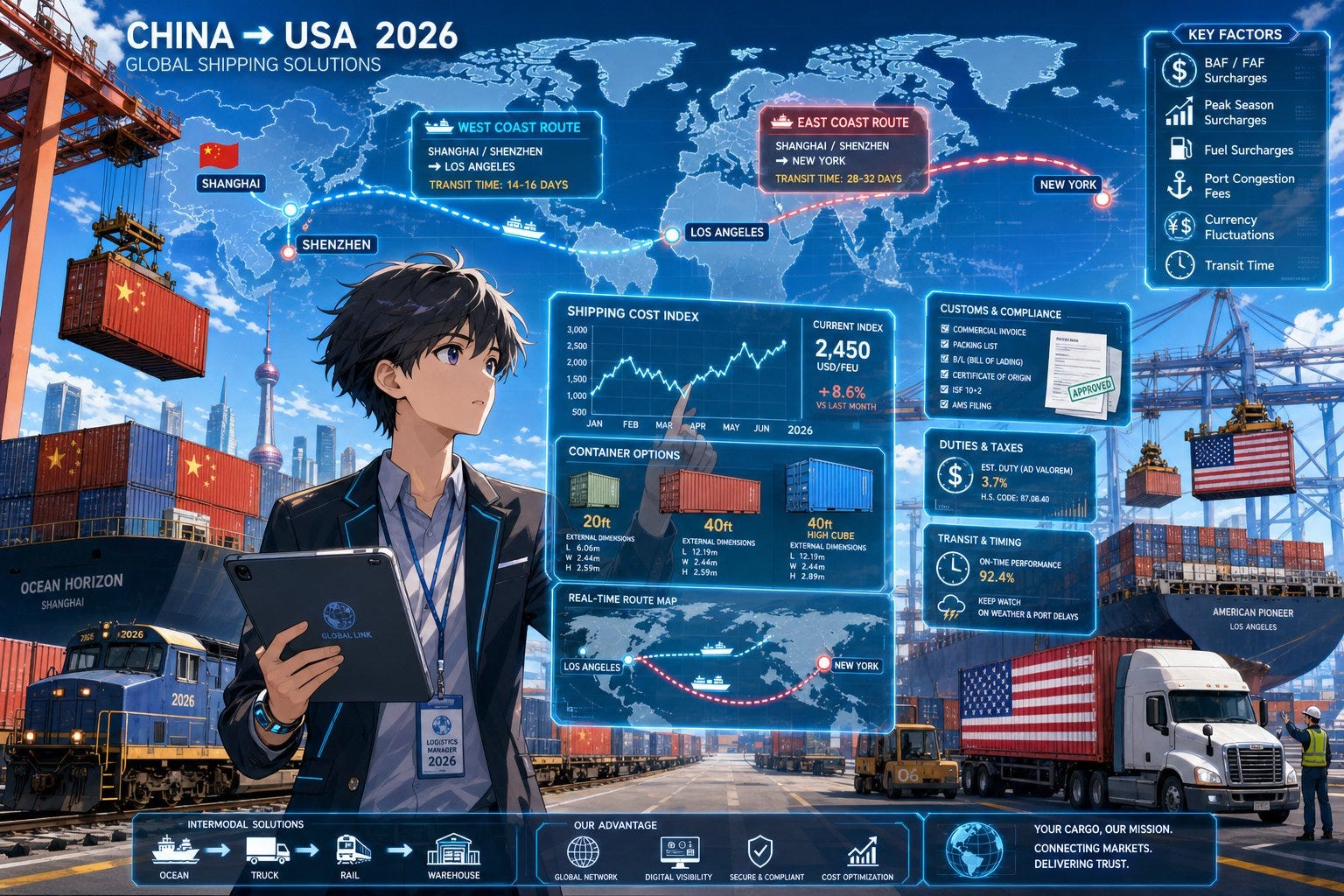
Container shipping costs China to USA are a big deal for anyone moving goods internationally. Right now, if you’re shipping a 40-foot container, you’ll see prices ranging from about $2,100 to $3,350, depending on whether you’re heading to the West Coast or East Coast.
That’s just the start, though. Your final price depends on container size, shipping route, time of year, and a handful of extra fees that seem to pop up everywhere.
Ocean freight is still the most affordable way to move big shipments across the Pacific. But let’s be honest—there’s more to the bill than the base shipping rate.
Surcharges, terminal handling, customs clearance, and paperwork charges all creep into your total. It’s easy to miss something unless you’re watching closely.
This guide unpacks what you need to know about container shipping costs China to USA. We’ll look at choosing between full container load and less than container load, compare shipping routes, check out current rates, and toss around a few ideas for saving money on shipping expenses.
Contents hide
2 Breakdown of Container Shipping Charges
2.1 Base Ocean Freight and Surcharges
2.2 Origin and Destination Port Fees
2.3 Customs and Compliance-Related Costs
3 FCL vs. LCL: Choosing the Right Container Solution
3.2 Less Than Container Load (LCL) and Consolidation
3.3 High Cube and Refrigerated Containers
3.4 FCL vs LCL Cost Comparison
4 Shipping Methods and Service Options
4.1 Container Shipping Costs China to USA: Door-to-Door, Port-to-Port, and Intermodal Options
4.2 DDP, CIF, and FOB Explained
5 Current Rates, Transit Times, and Key Shipping Routes
5.1 Popular China to USA Ports and Routes
5.2 West Coast vs. East Coast Shipping
5.3 Transit Time Factors and Seasonality
6 Documentation, Compliance, and Risk Management
6.1 Essential Shipping Documents
6.2 Customs Bonds, ISF, and Importer Requirements
6.3 Cargo Insurance and Loss Prevention
6.4 Demurrage, Detention, and Storage
7 Cost-Saving Tips and Choosing a Freight Forwarder
7.1 Comparing Quotes and Transparent Pricing
7.2 Reducing Hidden Fees and Surcharges
7.3 Best Practices for SMEs and FBA Sellers
7.4 Selecting Reliable Partners
9.1 What factors most influence ocean freight rates from China to the United States?
9.2 How much does it typically cost to ship a 40-foot container from China to the United States?
9.5 How do shipping costs compare between FCL and LCL for routes from China to U.S. ports?
RELATED Container Shipping Rates China to USA: Costs, Ports, and Process
Key Takeaways
Container shipping costs China to USA change with route, container size, and the season.
Understanding FCL and LCL options helps you avoid overpaying for space you don’t need.
Working with a seasoned freight forwarder and having your paperwork in order can cut delays and surprise fees.
RELATED Container Shipping Quotes China to USA: Costs, Routes, and Process Explained
Breakdown of Container Shipping Charges
When you’re shipping containers from China to the USA, your total cost is more than just the ocean freight. You’ll see layers of extra charges at different points in the process.
Base Ocean Freight and Surcharges
The base rate covers moving your container from one port to another. It’s the backbone of your shipping bill, but it’s never the whole story.
Rates swing up and down with supply and demand. Lately, Asia to US West Coast averages about $2,127 for a 40-foot box, while East Coast rates sit closer to $3,069.
Carriers tack on surcharges. The Bunker Adjustment Factor (BAF) reflects fuel cost changes and shows up on every bill. Peak Season Surcharge (PSS) kicks in before major holidays, making things pricier. If the port gets jammed, you’ll see port congestion fees, too.
Origin and Destination Port Fees
Origin charges start before your container even leaves China. Terminal Handling Charges (THC) pay for moving your box around the port, and documentation fees cover your bill of lading and paperwork.
Your freight forwarder manages export customs clearance in China, which usually adds $100 to $300, depending on how complex your shipment is.
When your container lands in the US, you’ll pay THC again at the destination port. There’s also the Harbor Maintenance Fee to support US ports, plus the Merchandise Processing Fee—usually 0.3464% of your cargo’s value, with a minimum of $27.23 and a max of $528.33 per entry.
Customs and Compliance-Related Costs
US customs clearance means more paperwork and fees. You’ve got to file your Importer Security Filing (ISF) 24 hours before loading, and the Automated Manifest System (AMS) filing lets customs check your shipment details.
Import duties and tariffs depend on your product’s classification. Your customs broker uses Harmonized Tariff Schedule codes to sort out the exact rate. Trade policies sometimes mean extra duties for certain products.
Customs brokerage fees usually land between $100 and $200 for standard shipments. If customs decides to physically inspect your container, expect extra inspection and handling charges—your broker will handle those, but you’ll see them on your bill.
Landed Cost Calculation
Landed cost is the grand total it takes to get your goods from a Chinese supplier to your warehouse. It’s ocean freight, all the surcharges, port fees, customs, duties, and the final delivery rolled into one.
Getting this number right matters. If you miss something, you could end up eating into your margins. You need to add up Chinese port charges, sea freight with its surcharges, US port fees, customs, duties, and last-mile delivery.
Asking for transparent quotes upfront is smart. Go for all-inclusive quotes that break down each charge, not just a lump sum. That way, you can spot what’s negotiable and see where you might trim your container shipping costs China to USA.
RELATED Sea Shipping Costs China to USA: 2026 Rates, Fees, and Strategies
FCL vs. LCL: Choosing the Right Container Solution
The container type you pick shapes your shipping costs China to USA. Most shipments fall into two camps: you either pay for the whole container, or you share space with other shippers and pay for what you use.
Full Container Load (FCL)
Full container load (FCL) gets you a container all to yourself. You pay a flat rate, no matter if you fill it to the top or not. Since your cargo stays sealed from port to port, there’s less handling and usually fewer issues.
FCL makes sense when your shipment is at least 15 CBM. At that point, the cost per cubic meter is often lower than LCL.
Standard container sizes look like this:
20-foot container: Up to 33 CBM, 28,000 kg
40-foot container: Up to 67 CBM, 29,000 kg
40-foot high cube: Up to 76 CBM, 29,000 kg
FCL shipping usually moves faster. Your container doesn’t wait for consolidation or deconsolidation, so your goods get picked up and delivered with minimal stops.
Less Than Container Load (LCL) and Consolidation
Less than container load lets you pay only for the space you use, measured in CBM. Freight forwarders combine shipments from different companies into one container.
You’ll need a CBM calculator for your volume—multiply length × width × height (in meters) for each box and add them up. Carriers also check your chargeable weight, just in case your shipment is bulky but light.
LCL is great for shipments under 15 CBM. You share container shipping costs China to USA with others, making it budget-friendly for smaller loads. But LCL can take longer, since your goods wait at consolidation warehouses in China and deconsolidation facilities in the USA.
Freight forwarders bill you for CBM or chargeable weight—whichever is higher. That keeps folks from sneaking in huge, lightweight shipments at a discount.
High Cube and Refrigerated Containers
High cube containers give you an extra foot of height. A 40-foot high cube is 9.5 feet tall (not 8.5), so you get 76 CBM instead of 67. You’ll pay 10-15% more, but you gain about 14% more space.
If you’re shipping tall but light goods, high cubes make sense.
Refrigerated containers (reefers) keep things cold for perishables. They cost two to three times as much as a standard container, and reefer rates include power charges at the port and on the ship.
Both high cube and reefers usually require FCL booking. Carriers rarely offer LCL for refrigerated cargo—too tricky to manage different temperature needs in one box.
FCL vs LCL Cost Comparison
Container shipping costs China to USA swing with the season, demand, and fuel prices. The break-even point between FCL and LCL is usually around 13-15 CBM.
LCL shipping costs include consolidation and deconsolidation fees on top of the per-CBM rate. FCL covers the whole container, but you’ll handle loading and unloading costs on your own.
Get quotes for both FCL and LCL if your volume is close to 15 CBM. Container shipping costs China to USA can shift the break-even point by a couple CBM depending on port and warehouse locations.
RELATED China to USA Shipping Cost: 2026 Rate Guide and Factors Affecting Freight Prices
Shipping Methods and Service Options
Besides picking ocean or air, you’ll need to decide how much of the process your forwarder manages and who’s responsible for costs at each step. The big choices? Scope of transport, which Incoterms you use, and whether air is worth it for your schedule.
Container Shipping Costs China to USA: Door-to-Door, Port-to-Port, and Intermodal Options
Door-to-door shipping is the all-in-one solution for moving your goods from a supplier’s factory in China to your warehouse or Amazon center in the USA. It covers pickup, ocean or air transit, customs clearance, and final delivery. You get one invoice and a single point of contact—much less hassle.
DDP door-to-door options even include import duties. That means no surprise fees, though you’ll usually see an 8–15% markup on the duty calculation.
Port-to-port shipping moves your container from a Chinese port to a US port terminal. You’ll need to handle and pay for drayage, customs brokerage, and final trucking yourself. This option gives you more cost transparency but adds a few headaches since you have to coordinate with several vendors.
Intermodal shipping mixes ocean, rail, and truck transport. Picture your container sailing to Los Angeles, then riding the rails to Chicago. Intermodal can chop inland trucking costs by 20–30% on long hauls, though you should expect it to add 2–5 days to your total transit time compared to a direct truck route.
DDP, CIF, and FOB Explained
Incoterms spell out who pays for what—freight, insurance, and risk—on China-to-USA shipments. The three big ones are FOB, CIF, and DDP.
FOB (Free On Board) means your supplier gets the cargo to the Chinese port and loads it up. You take it from there: pay ocean freight, insurance, US duties, and inland delivery. You get full control over carriers and rates, which can save you money.
CIF (Cost, Insurance, Freight) has the supplier pay ocean freight and basic insurance to the US port. You’re still on the hook for customs, duties, and last-mile delivery. Suppliers sometimes pad the CIF price, so FOB usually saves you 10–20%.
DDP (Delivered Duty Paid) puts everything—shipping, duties, and taxes—on the supplier, all the way to your US door. DDP shipping from China to USA keeps your workload light but hides the real freight and duty costs, which makes auditing tough.
Air Freight Alternatives
Air freight from China to the US usually runs $3.50 to $7.00 per kilogram, and gets there in 3–7 days. Chargeable weight is whichever is higher: actual or volumetric (length × width × height in cm ÷ 6,000). Bulky but light stuff? It gets pricey fast.
Air makes sense if your cargo is worth more than about $15 per kg, or when a stockout would cost you more than the air premium. For example, shipping 500 kg of electronics valued at $25,000 might cost $2,500 by air, versus $400 by ocean LCL. But if you need it fast, saving 25 days can justify the spend.
Sea-air hybrid routes send your cargo by ship to Dubai or Incheon, then by air to the USA. It takes 9–14 days and costs $2.50–$4.50 per kg—cheaper than direct air, faster than ocean. Express couriers (DHL, FedEx, UPS) charge $5–$10 per kg for 1–5 day delivery, which is best for samples or urgent parcels under 200 kg.
RELATED Sea Shipping Rates China to USA: Costs, Charges, and Key Factors
Current Rates, Transit Times, and Key Shipping Routes
Container Shipping Costs China to USA depend on the ports and routes you pick. The route and season both affect how fast your goods arrive and what you’ll pay.
Popular China to USA Ports and Routes
The top three shipping lanes for container shipping costs China to USA are Shanghai to New York, Shanghai to Los Angeles, and Shenzhen to Los Angeles. These routes handle most container traffic between the two countries.
Shanghai is China’s busiest port and connects to big US destinations on both coasts. Shenzhen and Ningbo are also major departure points for goods bound for America.
On the US side, Los Angeles and Long Beach dominate West Coast arrivals. New York and Newark process most East Coast shipments. Savannah and Houston sometimes offer less congestion and faster processing.
Your route really depends on where your goods need to end up. If you’re shipping to California, West Coast ports make sense. East Coast distribution centers usually benefit from direct Atlantic routes.
West Coast vs. East Coast Shipping
Shipping to the US West Coast usually costs less and arrives quicker than East Coast destinations. Transit times to Los Angeles or Long Beach average 12–16 days from China’s big ports. Routes to the US East Coast via the Panama Canal take 25–30 days.
Container costs from China to USA for a 40-foot container range from $2,930 to $4,930, depending on where you’re sending it. West Coast routes usually come in at the lower end.
Here’s the catch: if your customers or warehouses are on the East Coast, shipping to the West Coast plus cross-country trucking can cost more than direct to the East. Always calculate your total landed cost—including inland transport—before picking a route.
Transit Time Factors and Seasonality
Peak season (August through October) pushes up both transit times and container shipping costs China to USA. Demand spikes before the holidays, causing port congestion and fewer available containers.
Chinese New Year (January or February) also disrupts schedules as factories shut down and shipping slows. Try to plan at least two weeks before or after these periods to dodge delays.
Weather plays a role too. Typhoon season in the Pacific (June through November) can tack on extra days. Port congestion, customs delays, and carrier schedules all affect your real delivery date.
If you’re shipping during high-demand periods, book early. Seasonality can swing prices by 30–50% between low and peak seasons, so timing your orders well can save you a bundle.
RELATED Sea Shipping From China To USA: Complete Guide To Ocean Freight Services And Transit Times
Documentation, Compliance, and Risk Management
Proper paperwork and compliance keep you safe from penalties—those can run $5,000 to $10,000 per violation. Knowing about bonds, insurance, and storage fees can help you avoid nasty surprises that eat into profits.
Essential Shipping Documents
Every container shipment needs three key documents: the bill of lading, commercial invoice, and packing list. The bill of lading is your receipt from the carrier and proves you own the goods in transit.
The commercial invoice must list exactly what’s inside—product descriptions, quantities, values, and sale terms. The packing list details box contents and how everything’s arranged in the container. You also need the right HS codes for your products, since these set your tariff rates. Mess up the codes, and you could face delays, wrong duties, or customs exams.
All your documents have to match, line for line. Even one mismatch between your invoice and packing list can trigger a customs hold. Keep both digital and paper copies for at least five years, since customs can audit shipments years after they clear.
Customs Bonds, ISF, and Importer Requirements
US importers must file an Importer Security Filing (10+2) at least 24 hours before loading the container on the vessel. You’ll need to give details about your supplier, manufacturer, and cargo. If you miss the ISF deadline, you get hit with an automatic $5,000 penalty.
A customs bond is required to clear goods through US customs. A single entry bond covers one shipment and costs $50–$200, depending on value. If you ship often, an annual bond usually makes more sense.
Your customs broker files the ISF and entry paperwork. Make sure your broker is licensed by US Customs and Border Protection. You also need to register as the importer of record, which makes you legally responsible for the goods. You’ll need an Employer Identification Number from the IRS for this step.
Cargo Insurance and Loss Prevention
Cargo insurance protects you if your goods get lost or damaged. Standard coverage costs 0.1% to 0.5% of the cargo’s value. If you skip insurance, you only get the carrier’s limited liability—just $500 per container for ocean freight.
Get a policy that covers all risks, from factory to final destination. That means loading accidents, container damage, theft, and natural disasters. Take photos before shipping to document your cargo’s condition.
Premiums depend on the product, route, and claims history. Electronics and high-value goods cost more to insure than everyday items. Some forwarders include basic coverage, but you’ll usually want extra protection for full replacement value.
Demurrage, Detention, and Storage
Demurrage fees kick in if you don’t pick up your container from the port within the free window—usually 3 to 5 days. These start at $75 to $150 per day and jump higher after 10 days, sometimes up to $300 daily.
Detention charges apply if you keep the container too long after pickup. You generally get 3 to 7 days to unload and return it. Detention rates match demurrage and add up fast.
Plan your pickup before your container arrives. Double-check that your CFS warehouse or destination can receive it right away. If customs selects your shipment for inspection, you’ll pay storage fees at the exam site—typically $25 to $75 per day.
Track your container’s arrival and work with your customs broker to clear it quickly. Set aside $500 to $1,000 for possible demurrage and detention, especially during peak season when ports get jammed up.
RELATED Shipping Freight From China to the USA: Essential Guide for Import Businesses
Cost-Saving Tips and Choosing a Freight Forwarder
Cutting container shipping costs China to USA takes more than just chasing the lowest rate. You have to compare quotes, spot hidden fees, and work with reliable forwarders who know your business.
Comparing Quotes and Transparent Pricing
Get quotes from at least three to five freight forwarders to compare pricing. Don’t just look at the base ocean or air freight rate.
A real quote should include:
Origin charges (pickup, paperwork, export customs)
Ocean or air freight costs
Destination charges (customs clearance, delivery, chassis rental)
Fuel surcharges and security fees
Some forwarders advertise rock-bottom rates, then tack on fees later. Always ask for an all-inclusive door-to-door quote that lists every charge. This way, you won’t get blindsided when your container lands.
Transparent pricing lets you see exactly what you’re paying for inland trucking, storage, and terminal handling. Compare these details across providers to find the best value for your shipment.
Reducing Hidden Fees and Surcharges
Container Shipping Costs China to USA can sneak up on you, especially with hidden fees. These charges—like detention if you don’t pick up your container fast enough, or storage fees at the port—can add hundreds or even thousands to your final bill.
Last-minute documentation fees are another common surprise. To avoid detention, make sure you coordinate your warehouse receiving times before your shipment arrives.
Most ports only give you a few free days before storage fees kick in. Trucking companies also charge chassis rental fees when moving your container from the port.
Ask your freight forwarder whether chassis costs are included or billed separately. Some forwarders can negotiate lower chassis rates thanks to volume deals.
Peak season surcharges pop up during busy times like summer and fall. Book your space early or consider shipping during slower months to dodge those extra costs.
If you work with experienced freight forwarders, you’ll usually save more through better planning and negotiation.
Best Practices for SMEs and FBA Sellers
Small and medium businesses, plus Amazon FBA sellers, often don’t fill a whole container. If that’s you, try consolidating shipments with other importers to split container costs and get FCL rates instead of expensive LCL pricing.
Many forwarders offer consolidation services, combining cargo from different clients. This is usually the cheapest way to ship from China to USA if you’re moving 5 to 15 cubic meters at a time.
Amazon FBA sellers need precise delivery timing to avoid those strict appointment windows. Pick a forwarder who knows Amazon’s rules and can schedule deliveries and handle labeling.
Missed appointments mean rejection fees and storage charges, so timing really matters. Plan your inventory at least 60 to 90 days ahead if you’re using ocean freight.
This buffer keeps you from scrambling for expensive air freight when stock runs low. It’s way more cost-effective to plan ahead than to order reactively.
Selecting Reliable Partners
Your freight forwarder manages thousands of dollars in cargo and lots of customs paperwork. Pick partners with real experience in US imports and solid relationships with carriers.
Check their credentials. Look for:
Valid licensing: FMC (Federal Maritime Commission) registration for ocean freight
Industry memberships: Affiliations with NVOCC or freight associations
Insurance coverage: They should have proper cargo insurance
Technology platforms: Modern forwarders offer real-time tracking and online docs
Ask for references from other US importers in your field. A reliable partner answers questions fast and keeps you in the loop about any delays or issues.
Be wary of forwarders who demand full payment upfront or won’t give detailed invoices. Established companies usually offer net payment terms after you build some trust, and they’ll explain all charges clearly so you actually understand the full cost structure.
RELATED Sea Shipping Quotes China to USA: Complete Cost & Process Guide
About AEB Logistics
AEB Logistics specializes in Container Shipping Costs China to USA. They’re a global freight forwarder handling air freight, ocean freight, express delivery, and door-to-door solutions for all sorts of businesses.
When you ask AEB Logistics for a quote, you’ll get a detailed response within 24 hours. That quick turnaround helps you plan and budget without a ton of back-and-forth.
Core Services:
Full Container Load (FCL) shipping
Less Than Container Load (LCL) shipping
Air freight and express delivery
DDP (Delivered Duty Paid) solutions
Amazon FBA logistics support
Transparent pricing is a big deal for them. You know exactly what you’ll pay—no surprise fees or hidden charges when your shipment lands.
AEB Logistics gives you end-to-end control of your freight, from pickup in China to final delivery in the USA. You’re not stuck juggling different carriers or customs brokers.
They serve small businesses and big companies with the same attention to detail. Whether you ship one pallet or a bunch of containers, you get reliable service that makes international trade less stressful.
They also handle compliance and customs docs, so you don’t have to guess or worry about delays at the port.
RELATED Container Shipping Rates China to USA: Costs, Ports, and Process
Frequently Asked Questions
Container Shipping Costs China to USA depend on several things: container size, route, season, and even fuel prices. Knowing these factors helps you budget and avoid surprise expenses.
What factors most influence ocean freight rates from China to the United States?
Supply and demand drives most rate changes. If more importers want containers than carriers can handle, prices go up.
When there’s extra capacity, rates fall. Fuel prices also play a big role, since bunker adjustment factors can add hundreds to your rate in just a month.
Seasonal demand matters, too. During the August to October peak, rates can jump by $1,000 to $2,000 per container as retailers stock up for the holidays.
Congestion at big ports like Los Angeles or Long Beach slows container turnover. That means fewer available boxes and higher costs.
Your route affects pricing as well. Shipping to West Coast ports usually costs less than going to the East Coast, thanks to shorter transit times and more competition.
Container type and cargo requirements also matter. Standard dry containers are cheaper than refrigerated or specialty units.
How much does it typically cost to ship a 40-foot container from China to the United States?
Shipping a 40-foot container from China to the US West Coast usually costs $2,100 to $3,000. If you’re heading to the East Coast, expect $3,350 to $5,000 per container.
Rates change constantly with the market. The price difference between a 20-foot and 40-foot container is usually just 20-25%, so the bigger box gives you better value per cubic foot.
Current container rates reflect pricing from major ports like Shanghai, Ningbo, and Shenzhen to US destinations. Your actual quote depends on which ports you use and when you book.
High cube 40-foot containers cost a bit more than standard ones. Expect $2,200 to $5,500 for high cube, depending on your route.
Peak surcharges can tack on another $500 to $2,000. Always ask for quotes that include these extras so you know your true cost.
How do I estimate shipping charges by weight (per kg or per lb) for shipments from China to the United States?
Weight-based pricing mostly applies to air freight and LCL ocean shipping. For air freight, plan on $3 to $5 per kilogram for standard service from China to the USA.
Express shipping with DHL, UPS, or FedEx is about $5 per kilogram for packages up to 150 kg. These services are faster and offer door-to-door convenience.
Air carriers use either actual or dimensional weight, whichever is higher. Dimensional weight comes from multiplying length, width, and height (in cm), then dividing by 5,000 or 6,000.
For LCL ocean freight, you’re usually charged by cubic meter, not weight. But if your cargo is really dense, carriers might charge by weight instead.
The break-even between air and sea shipping falls around 150 to 500 kg. Below 150 kg, express shipping can make sense. Above 500 kg, sea freight is more economical.
Always get quotes in both weight and volume so you can see which method fits your shipment best.
What fees beyond the ocean freight rate should I expect (port charges, customs, chassis, drayage, and delivery)?
The base ocean freight rate is just the start. Port handling fees at origin and destination add $200 to $500 per container.
Terminal handling charges show up on most invoices. Destination terminal fees usually run $300 to $600, depending on port and container size.
Customs clearance fees include the Merchandise Processing Fee at 0.3464% of your cargo value (minimum $27.75, max $538.40). The Harbor Maintenance Fee adds another 0.125% of value.
Customs brokers charge $100 to $200 per entry to handle paperwork and clearance. If CBP inspects your container, plan on another $300 to $600 in exam fees.
Chassis rental costs $25 to $50 per day while your container sits on the equipment. Drayage from port to warehouse varies by distance but usually starts around $200 to $400 for local moves.
Documentation fees cover bills of lading, invoices, and certificates, typically adding $50 to $150 to your total.
Fuel surcharges change monthly with oil prices. They can add 10-25% to your base rate, so always check if fuel is included in your quote.
How do shipping costs compare between FCL and LCL for routes from China to U.S. ports?
FCL makes sense if your cargo volume is 15 cubic meters or more. You pay one flat rate for the whole container, no matter how full it is.
LCL shipments cost $50 to $150 per cubic meter from China to the USA. This works better for smaller loads that don’t fill a container.
For a 20-foot container, FCL rates range from $1,500 to $3,500. If you only have 10 cubic meters, LCL at $100 per CBM would cost $1,000—less than paying for an empty container.
FCL moves faster since your container isn’t consolidated with other shipments. LCL adds a week or two for extra handling on both ends.
Once you pass 15 CBM, FCL’s per-cubic-meter cost drops a lot. A 40-foot container holds about 67 CBM, so your per-CBM cost might be $30 to $75 instead of $100+.
LCL involves more touchpoints, which can slightly increase damage risk. But you avoid paying for empty space, so it’s usually the more affordable move for smaller shipments.
Container Shipping Costs China to USA: Which online tools or methods can I use to calculate an accurate door-to-door shipping quote from China to the USA?
If you’re trying to figure out container shipping costs China to USA, you’re not alone. The process can feel overwhelming, especially with all the variables. There are several online calculators out there. Some freight forwarders offer instant quote tools right on their websites. You’ll usually need to enter details like the pickup location in China, delivery address in the USA, container size, and maybe some info about your goods. These tools crunch the numbers and give you a ballpark estimate.
For more tailored results, you can try platforms like Freightos, iContainers, or Shippo. They let you compare rates from multiple carriers. It’s smart to double-check rates directly with a few freight forwarders too. Sometimes, you’ll get a better deal or more up-to-date info that way. Don’t forget to factor in things like customs, insurance, and possible surcharges. The cheapest quote isn’t always the best fit for your needs. Honestly, it’s worth spending a bit of extra time to compare and ask questions. Container shipping costs China to USA can change fast, so staying informed helps you avoid surprises.
Related Posts
Container Shipping Rates China to USA: Costs, Ports, and Process
Container Shipping Quotes China to USA: Costs, Routes, and Process Explained
Sea Shipping Costs China to USA: 2026 Rates, Fees, and Strategies
China to USA Shipping Cost: 2026 Rate Guide and Factors Affecting Freight Prices
Sea Shipping Rates China to USA: Costs, Charges, and Key Factors