

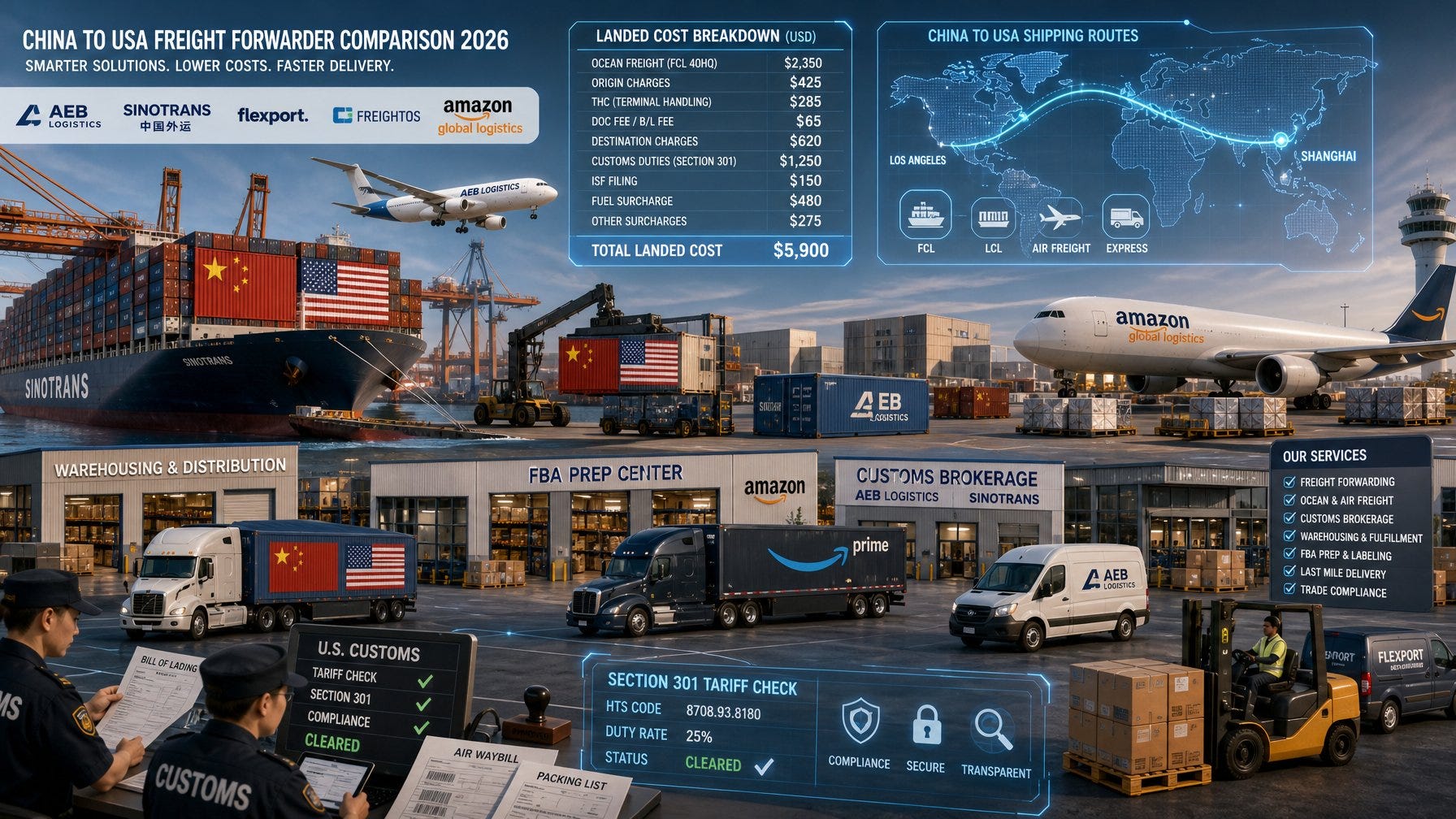
Picking the right freight forwarder for your China to USA shipments affects everything from your shipping costs to how fast your products reach customers.
The wrong partner can hit you with hidden fees, customs delays, and delivery problems that hurt your bottom line. The right one helps you move goods smoothly while keeping your total landed cost under control.
Freight forwarders differ widely in warehouse networks, customs brokerage strength, shipping options, and pricing transparency, so comparing them on these key factors helps you find the best fit for your importing needs.
Some forwarders only handle basic transport while others offer warehousing, FBA prep, and customs support. Your choice depends on whether you ship full containers or small parcels, need Amazon delivery, or want someone to manage duties and compliance for you.
This guide breaks down how to compare China to USA freight forwarders by the services that matter most for international logistics. You’ll learn how to evaluate shipping modes, spot hidden charges, understand customs requirements, and calculate your real landed cost so you can make a smart decision for your business.
Contents hide
2 Evaluating Freight Forwarder Capabilities
2.1 Traditional vs. Digital Models
2.2 Key Criteria: Warehousing, Service Scope, and Technology
2.3 Top Providers: AEB Logistics, Sinotrans, Flexport, Freightos, and Amazon Global Logistics
3 Shipping Modes and Cost Breakdown
3.1 Ocean Freight: FCL, LCL, DDP Sea, Port-to-Port
3.2 Air Freight and Express Courier Solutions
3.3 Key Pricing Elements: Surcharges, Destination Charges, and Fuel
3.4 Total Landed Cost and Incoterms
4 Customs Clearance and Compliance Essentials
4.1 Role of Customs Brokers and ISF Filing
4.2 Key Documents: Bill of Lading, Air Waybill, and Packing List
4.3 Tariffs, Section 301, and De Minimis Exemption Updates
4.4 Customs Delays, Demurrage, and Detention
5 Final Delivery, FBA, and Logistics Optimization
5.1 Amazon FBA and Appointment Delivery Requirements
5.2 Warehousing, Inland Trucking, and Last-Mile Logistics
5.3 Cargo Insurance and Risk Management
6.4 What fees should be itemized to confirm pricing transparency and avoid surprise surcharges?
RELATED China to USA Freight Forwarders: 2026 Comparison, Costs, and Best Services
Key Takeaways
Freight forwarders vary in service scope from basic transport to full customs clearance, warehousing, and Amazon FBA delivery
Transparent pricing that includes all fees helps you avoid surprise costs and accurately calculate your total landed cost
Strong customs brokerage and compliance support prevent delays and keep your shipments moving through US ports smoothly
RELATED China to USA Freight Forwarders: Compare Top Logistics Partners for 2026
Evaluating Freight Forwarder Capabilities
The gap between large global logistics networks and specialized China-focused providers shapes how your cargo moves, clears customs, and reaches your warehouse.
Pricing models and technology platforms differ widely across traditional freight forwarding companies and newer digital-first options.
Traditional vs. Digital Models
Traditional international freight forwarders like Sinotrans operate through relationship-based networks with physical offices in major Chinese ports and US gateway cities.
You work with account managers who handle quotes, booking, and coordination manually.
Digital freight forwarders such as Freightos provide online platforms where you can compare freight rates, book shipments, and track containers without phone calls or email chains.
These platforms show real-time pricing and automate documentation. It’s honestly a relief not to chase emails sometimes.
Traditional strengths:
Established relationships with carriers and customs brokers
Experience handling complex consolidation and special cargo
Direct staff at origin for factory pickup coordination
Digital advantages:
Instant rate comparison across multiple carriers
Transparent pricing without hidden fees
Self-service booking and documentation tools
Your choice depends on shipment complexity and volume.
High-value or oversized cargo often benefits from traditional providers, while regular Amazon FBA shipments suit digital platforms.
Key Criteria: Warehousing, Service Scope, and Technology
Choosing the right freight forwarder means looking at more than just shipping costs.
Operational capabilities matter a lot.
Warehouse network: Check if the forwarder operates 3PL facilities near major US ports and your final destination.
Warehousing services enable consolidation, quality inspection, and direct distribution to multiple locations.
Customs brokerage: Your freight forwarder should include customs broker services or partner with licensed brokers who understand product classifications, duty rates, and FDA or FCC requirements.
Poor customs support creates costly delays.
Technology platform: Request access to tracking dashboards, automated alerts, and documentation portals.
Basic email updates usually mean limited technical infrastructure.
Service scope: Confirm the forwarder handles your specific needs—Amazon Global Logistics preparation, temperature-controlled shipping, or hazardous materials certification.
Top Providers: AEB Logistics, Sinotrans, Flexport, Freightos, and Amazon Global Logistics
Sinotrans operates as China’s largest state-owned freight forwarding company with extensive warehouse facilities across Chinese manufacturing regions.
Their strength lies in factory pickup coordination and consolidation at origin ports.
Flexport combines digital booking platforms with dedicated account teams and operates bonded warehouses near Los Angeles and New York ports.
They specialize in FBA logistics with Amazon-ready prep services.
Freightos functions as a freight rate comparison marketplace connecting you with multiple carriers and forwarders.
You get transparent pricing but less hands-on support for complex shipments.
Amazon Global Logistics provides end-to-end service exclusively for Amazon FBA sellers, handling ocean freight, customs clearance, and direct delivery to fulfillment centers.
Pricing remains competitive only for standard containerized cargo.
AEB Logistics focuses on compliance-heavy industries requiring specialized customs brokerage and detailed documentation support across multiple product categories.
RELATED Freight Forwarding Services: Comparing China–USA Providers
Shipping Modes and Cost Breakdown
Freight forwarders offer multiple shipping modes from China to the USA, each with different speed, capacity, and pricing structures.
Understanding ocean freight, air freight, express options, and the charges that make up your total landed cost helps you compare quotes accurately and choose the right service level.
Ocean Freight: FCL, LCL, DDP Sea, Port-to-Port
Ocean freight divides into full container load (FCL) and less than container load (LCL) options.
FCL means you book an entire container—typically a 20ft container or 40ft high-cube—for your exclusive use. LCL means your cargo shares space with other shipments, and you pay per cubic meter.
July 2026 sea freight rates show 20GP containers at $5,400–$6,600 and 40HQ at $6,075–$7,425 to major US ports.
LCL firmed to $130 per cubic meter. The choice between LCL vs FCL depends on volume: shipments under 15 cubic meters usually cost less via LCL, while larger volumes justify FCL.
Port-to-port pricing covers only ocean transport from China port to US port.
You handle pickup, customs brokerage, and final delivery separately. DDP sea (delivered duty paid) includes origin pickup, ocean freight, US customs clearance, duty payment, and door-to-door delivery to your warehouse.
DDP shipping costs more upfront but simplifies logistics and gives you a single invoice.
Air Freight and Express Courier Solutions
Air freight moves cargo faster than ocean—typically 2-3 days for major gateways.
You pay per kilogram based on chargeable weight, which is the greater of actual weight or volumetric weight (dimensional weight calculated as length × width × height ÷ 6,000 for air shipments).
Current air freight rates sit at $7.40 per kilogram for shipments over 1,000 kg to Los Angeles, New York, and Miami.
Express courier services like DHL, FedEx, and UPS charge around $17.11 per kilogram but deliver door-to-door in 2-4 days with built-in customs clearance.
Air freight works best for time-sensitive or high-value products where inventory turnover justifies the premium.
Express courier suits smaller urgent shipments under 500 kg. DDP air combines air freight with customs brokerage and final delivery, reducing your administrative workload while maintaining fast transit.
Key Pricing Elements: Surcharges, Destination Charges, and Fuel
Freight quotes include base rates plus multiple surcharges.
Ocean freight adds bunker adjustment factor (fuel surcharge), peak season surcharges, and equipment imbalance fees. Air freight includes fuel surcharges and security fees. These surcharges fluctuate monthly based on fuel prices and capacity.
Origin charges in China cover pickup, export customs, and terminal handling.
Destination charges at US ports include unloading, container return, and drayage to the warehouse. Port congestion at Los Angeles and Long Beach can trigger additional fees during peak periods.
Common surcharge categories:
Fuel surcharges – Adjust monthly based on fuel costs
Peak season – June through October for ocean freight
Equipment positioning – When empty containers are scarce
Security screening – Required for air and express shipments
Ask forwarders for all-in quotes that include origin charges, destination charges, and typical surcharges.
A base rate of $5,400 for a 20ft container might reach $7,200 after fees.
Total Landed Cost and Incoterms
Total landed cost adds freight, duties, taxes, insurance, and handling to your product cost.
It represents the true expense of getting goods to your door. Understanding import taxes helps you budget accurately—electronics face 2-6% duty rates while apparel can reach 16-20%.
Incoterms define who pays what and when risk transfers. FOB (free on board) means you pay from the China port onward.
CIF (cost, insurance, freight) includes ocean freight and insurance to the US port, but you handle customs and inland delivery. DDP transfers all costs and risk to the seller or forwarder until delivery to your specified address.
Your commercial invoice must list accurate HS codes, values, and shipment details for customs clearance.
Freight forwarders offering customs brokerage services file your entry documents and calculate duties. Comparing total landed cost across forwarders—not just freight rates—reveals the true expense difference and prevents budget surprises at delivery.
RELATED Freight Forwarder China To USA: Essential Guide For Efficient International Shipping
Customs Clearance and Compliance Essentials
Understanding customs clearance procedures and compliance requirements directly impacts your shipping timeline and total landed cost.
The right freight forwarder should provide expert customs brokerage support, handle mandatory filings, and keep you informed about tariff changes that affect your bottom line.
Role of Customs Brokers and ISF Filing
A customs broker acts as your licensed representative with US Customs and Border Protection. They prepare and submit entry documents, calculate duties, and make sure your shipment meets all federal regulations.
Most China to USA freight forwarders either have in-house customs brokers or they work with established customs brokerage firms.
The Importer Security Filing, or ISF 10+2, is mandatory for all ocean cargo entering the US. You have to submit this filing at least 24 hours before your container gets loaded at the Chinese port.
The ISF includes ten data elements from you as the importer and two from your carrier. If you miss the filing deadline, you face a $5,000 penalty per violation.
Your cargo could also get stuck in intensive inspections or face delays at the port. A good freight forwarder automates ISF filing and sends reminders so you avoid these headaches.
Key Documents: Bill of Lading, Air Waybill, and Packing List
Your commercial invoice is the main document for figuring out duties and taxes. It needs to show the buyer, seller, country of origin, product details, unit prices, and total value.
Even small mistakes in this document can trigger customs holds or extra inspections. The packing list gives weight, dimensions, and packaging details for each item in your shipment.
Customs officials use it to check container contents against your invoice. Discrepancies in quantities or weights can cause delays and extra fees.
A bill of lading (for ocean freight) or air waybill (for air freight) acts as your receipt, contract, and title document. You need this to claim your goods at the destination.
It lists tracking numbers, container info, and shipping marks you’ll need to monitor your cargo. Sometimes you’ll also need a certificate of origin, FDA registration for food or cosmetics, or FCC compliance for electronics.
Your freight forwarder should give you a checklist tailored to your product type.
Tariffs, Section 301, and De Minimis Exemption Updates
Every product entering the US gets an HS code that sets the duty rate. Picking the right HS code matters—mistakes mean you might overpay or get audited.
Your customs broker should double-check classifications using the Harmonized Tariff Schedule. Section 301 tariffs are still in effect for many Chinese goods in 2026.
These extra duties run from 7.5% to 25% depending on the product. Confirm the current tariff status of your items before you accept a quote so you know your total landed cost.
The de minimis exemption used to allow duty-free entry for shipments under $800. Recent rule changes have affected this for some Chinese imports.
Your freight forwarder should stay up to date and advise you on the best entry methods. Merchandise Processing Fees and Harbor Maintenance Fees also apply to most shipments.
These percentages seem small but add up fast on high-value containers.
Customs Delays, Demurrage, and Detention
Customs clearance usually takes two to five days after your cargo lands at the US port. Delays happen if CBP flags your shipment for inspection or if there are errors in your documents.
In 2026, customs officials use AI screening tools to spot discrepancies faster than ever. Demurrage charges start when your container sits at the port terminal past the free time, typically three to five days.
Detention fees apply if you keep the carrier’s container at your warehouse too long. Both fees can hit $100 to $200 per container per day.
A freight forwarder that offers destination handling and warehouse services can help you avoid these costs. They’ll move your goods from the port to a nearby facility quickly, giving you time to arrange final delivery.
As the importer of record, you’re legally responsible for all duties, taxes, and compliance. Choose a forwarder who communicates clearly about customs status and fixes problems before they get expensive.
RELATED Freight forwarding from China to USA: How to Choose a China to USA Freight Forwarder?
Final Delivery, FBA, and Logistics Optimization
Getting your cargo from port to Amazon fulfillment center means dealing with appointment scheduling, labeling, and insurance. A strong inland trucking network and flexible warehousing help you dodge delivery delays and keep costs predictable.
Amazon FBA and Appointment Delivery Requirements
Amazon requires appointment delivery for all FBA shipments. You can’t just show up at a fulfillment center without a scheduled time slot.
Your freight forwarder should handle scheduling through Amazon’s Carrier Central and coordinate with their trucking partners. FBA logistics providers also manage labeling before your shipment arrives.
Amazon needs specific carton labels with FNSKU barcodes and proper shipment IDs. Good forwarders offer FBA prep services and apply these labels at their warehouse before delivery.
Key FBA services to look for:
Appointment booking at Amazon fulfillment centers
FNSKU labeling and box marking
Pallet configuration that meets Amazon’s requirements
Direct delivery to multiple FC locations
Ask your forwarder how they handle rejected shipments or missed appointments. Delays at the fulfillment center can trigger storage fees and cause inventory shortages that hurt your sales.
Warehousing, Inland Trucking, and Last-Mile Logistics
Inland delivery from US ports to your warehouse uses either LTL (less than truckload) or FTL (full truckload) shipping. A forwarder with strong 3PL partnerships can get you better rates and more flexible delivery times.
Consolidation services let you combine shipments from different suppliers into one container before final delivery. This cuts your per-unit shipping cost and makes receiving easier at your warehouse.
Your carton count affects inland trucking costs since carriers charge by weight and space. Forwarders with their own warehouses near major ports can receive your container, store inventory short-term, and ship smaller batches as needed.
Cargo Insurance and Risk Management
Cargo insurance protects your shipment’s value if something goes wrong during transit. Most forwarders offer insurance at 0.3% to 0.5% of your cargo value.
Standard coverage protects against physical damage, theft, and total loss during ocean or air freight. Order protection programs add coverage for customs seizures, quality defects, and supplier failures that basic insurance doesn’t cover.
Your forwarder should explain what their insurance actually covers. Some policies exclude certain damage types or cap payouts per container, so read the details before you assume you’re covered for everything.
Insurance gets more important for high-value electronics, fragile items, or time-sensitive inventory. Honestly, it’s usually worth it compared to losing a shipment with no way to recover the value.
RELATED Ultimate Guide: Finding the Best Freight Forwarder from China to the USA
Frequently Asked Questions
Choosing the right forwarder means comparing specific capabilities like warehouse locations, customs expertise, shipping modes, fee structures, landed cost calculations, and service reliability. These six questions cover the most important decision factors for US importers working with China suppliers.
How do you compare forwarders based on warehouse network coverage and consolidation options in China and the US?
Start by mapping your supplier locations against the forwarder’s China warehouse network. A forwarder with facilities in Shenzhen, Guangzhou, and Shanghai can handle most South China manufacturing regions.
Ningbo and Yiwu coverage helps with East China sourcing. Ask each forwarder how many pickup locations they operate.
The best consolidation happens when your forwarder can collect from multiple suppliers in the same city and combine everything at one warehouse before export. Check their US destination capabilities too.
You need delivery options that match your business model—whether that’s direct to Amazon FBA centers, your own warehouse, or retail locations. Free storage days matter for consolidation efficiency.
Most China forwarders offer 5-10 days of free warehousing, so you have time to collect goods from different suppliers before shipping.
What services should you expect for customs clearance support, and when do you need a licensed customs broker?
Every commercial shipment from China needs customs clearance in the US. Your forwarder should either have licensed customs brokers or work with established brokerage firms.
The customs broker files your entry documents with US Customs and Border Protection. They prepare the commercial invoice, packing list, and other paperwork using your product’s HS codes.
Check if customs brokerage is included in your quoted freight rate or charged separately. Some forwarders bundle it into DDP (Delivered Duty Paid) pricing, while others list it as a separate fee—usually $75 to $150 per shipment.
Ask about ISF (Importer Security Filing) capabilities. Your forwarder must file ISF at least 24 hours before your ocean container leaves China, or you’ll face penalties around $5,000 per shipment.
The new customs enforcement rules from June 2026 require stronger Importer of Record compliance. Your forwarder should walk you through these requirements and help keep you in good standing with CBP.
Which shipping mode is best for your shipment size and timeline—air, ocean (FCL/LCL), rail-to-sea, or express?
Ocean LCL works for shipments under 15 cubic meters when you have 25-40 days before inventory runs out. You pay only for the container space your cargo takes up, which is great for smaller volumes.
FCL is more economical above 15 cubic meters. Ocean freight rates in mid-2026 hit nearly $5,000 per container to the West Coast and $6,000 to the East Coast, with prices rising every couple of weeks.
Air freight costs $4 to $8 per kilogram and delivers in 5 to 11 days door-to-door. It’s a good fit for urgent restocks, product launches, or high-value items where speed matters more than cost.
Express courier services like DHL or FedEx deliver in 2 to 5 days at $8 to $12 per kilogram. Use express for samples, emergencies, or really small shipments under 150 kilograms.
Rail-to-sea hybrid options are starting to pop up but are still rare for China-USA routes. Most forwarders stick to the main three: ocean, air, and express.
What fees should be itemized to confirm pricing transparency and avoid surprise surcharges?
A transparent freight quote breaks down every charge separately. Ocean freight quotes need to list the base rate, fuel surcharge, documentation fees, customs clearance, ISF filing, delivery to final destination, and any terminal handling charges that apply.
Watch for vague “all-in” pricing. If one forwarder quotes $3,500 “total” and another shows $2,800 ocean freight plus $400 customs plus $300 delivery, you really can’t compare them.
Fuel surcharges change all the time—sometimes monthly—and can tack on 18% to 28% to air freight base rates. Your forwarder should tell you the current fuel surcharge percentage and how often they update it. Otherwise, how are you supposed to budget?
Destination charges include port congestion fees, chassis fees, pier pass fees, and delivery appointments. These charges vary by US port and can add $200 to $500 per container on the West Coast.
Ask about minimum charges for small shipments. Many forwarders set minimums of $100 to $200 per air shipment, or $300 to $500 per ocean LCL shipment, no matter the actual weight or volume.
How do you calculate total landed cost, including duties, taxes, port fees, delivery, and compliance costs?
Total landed cost starts with your product’s FOB (Free On Board) value from the supplier. Then you add international freight costs, which include ocean or air transportation and fuel surcharges.
Import duties from China stack up across several layers in 2026. The blended effective tariff averages 33% of your shipment value, combining standard HTS rates, Section 301 tariffs, and other charges.
To calculate duties, multiply your product value by the total applicable tariff percentage. For example, a $10,000 shipment with 33% total duties means $3,300 in import taxes.
Add customs clearance fees ($75-$150), ISF filing ($25-$50), port charges ($200-$500 per container), and final delivery to your warehouse or FBA center. Delivery within 100 miles of the port usually costs $150 to $400 per container.
Don’t forget compliance costs like labeling, testing certificates, or FDA registration fees if your products require them. These one-time or periodic expenses can impact your true landed cost more than you might expect.
Related Posts
China to USA Freight Forwarders: 2026 Comparison, Costs, and Best Services
China to USA Freight Forwarders: Compare Top Logistics Partners for 2026
Freight Forwarder China To USA: Essential Guide For Efficient International Shipping
Freight forwarding from China to USA: How to Choose a China to USA Freight Forwarder?