

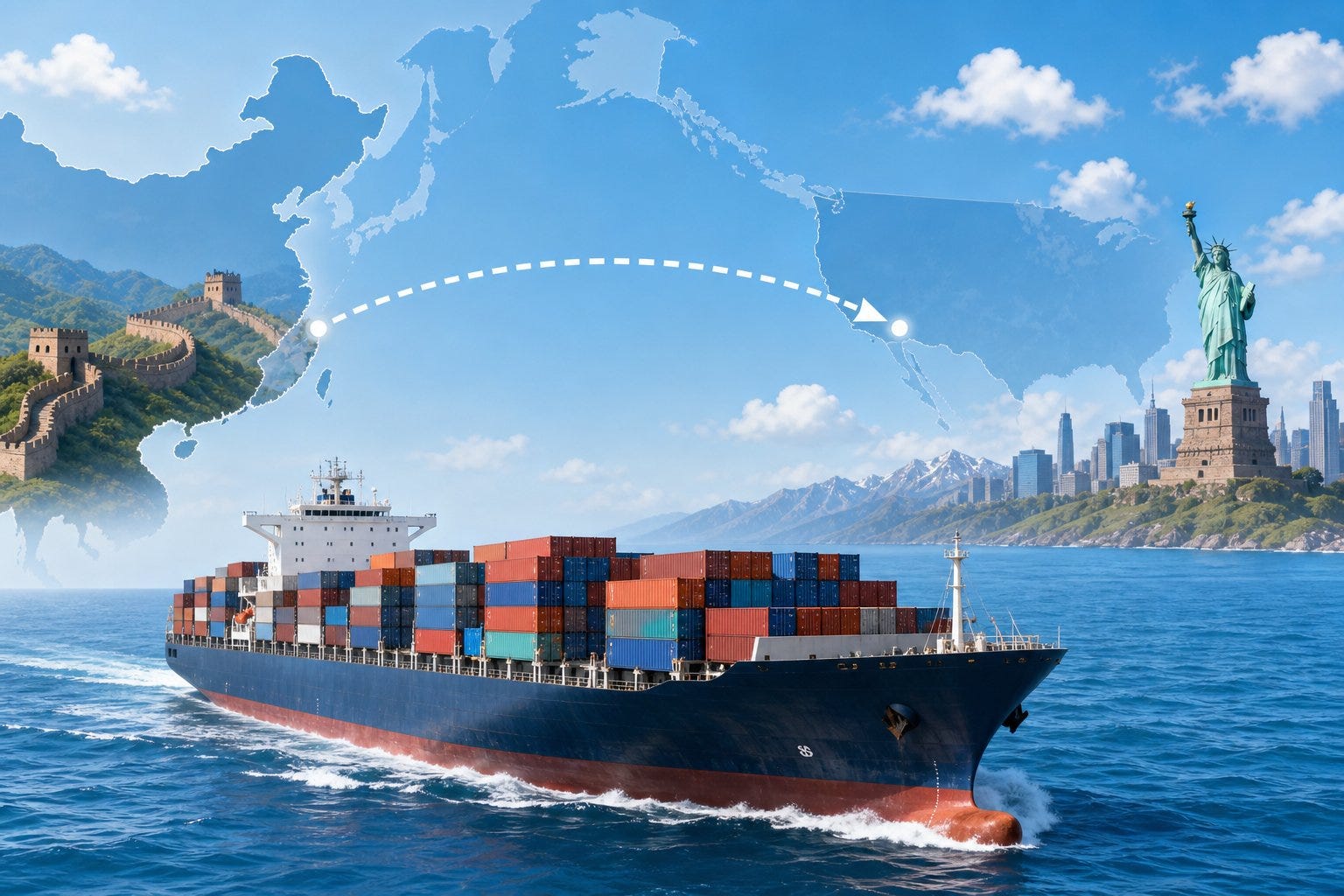
China to America Shipping is a massive industry, connecting businesses of all sizes to the US market. Every day, thousands of shipments move from China to America, making this route one of the busiest in global trade.
Whether you’re running a small shop or managing big import operations, understanding China to America Shipping is crucial. The main options—ocean freight, air freight, and express shipping—each come with their own price tags and delivery times.
International shipping from China to the US usually costs $3-5 per kilogram for air freight. Ocean freight is the cheapest for anything over 500 kg, with delivery times from 8-10 days by air and up to 30-40 days by sea.
Your choice depends on how much you’re shipping, your budget, and how quickly you need it. Shipping rates from China to USA change based on things like the type of goods and where exactly they’re going.
China to America Shipping isn’t just about moving boxes. You’ll need to think about customs clearance, freight forwarders, paperwork, and possible tariffs.
This guide gives you a real-world look at picking the right shipping method and getting your goods delivered. You’ll find tips to compare costs, dodge rookie mistakes, and work with logistics pros who can handle the tricky stuff in China to America Shipping.
Contents hide
2 Checking the Right Shipping Method
2.1 Sea Freight: Full Container Load and Less Than Container Load
2.2 Air Freight and Volumetric Weight Considerations
2.3 Express and Door-to-Door Services
3 Cost Factors and Pricing Structures
3.2 Total Landed Cost and DDP Solutions
3.3 Port Congestion and Seasonal Variability
4 Roles of Freight Forwarders and Incoterms
4.1 Understanding Incoterms: FOB, CIF, and DDP
4.2 Selecting a Freight Forwarder
4.3 Cargo Insurance and Risk Management
5 Customs Clearance and Regulatory Compliance
5.1 Customs Documentation and Importer of Record
5.2 Import Duties, Tariffs, and Taxes
5.3 US Customs Inspections and Section 301 Tariffs
6 Cargo Handling, Warehousing, and Final Delivery
6.1 Consolidation and LCL Services
6.2 Distribution Centers and Last-Mile Delivery
6.3 Special Considerations for Amazon FBA and E-Commerce
7 Strategies for Efficient and Reliable Shipments
7.2 Minimizing Delays and Reducing Costs
7.3 Best Practices for China to America Shipping: Compliance and Documentation
9.1 How long does it typically take for a shipment to arrive in the United States from China?
9.2 What factors most affect the total shipping cost for a package or freight shipment?
9.3 How can I track a shipment in transit and what tracking updates should I expect to see?
9.4 When should I choose air freight versus ocean freight for my shipment?
9.5 What customs duties, taxes, and import paperwork are commonly required for U.S. delivery?
RELATED China to USA Shipping: Complete Guide for Success
Key Takeaways
Pick your shipping method based on shipment size and speed—express for under 150 kg, air freight for 150-500 kg, ocean freight for heavy loads.
Partner with experienced freight forwarders who handle customs, paperwork, and tariffs to avoid delays and surprise costs.
Plan for 3 days with express, 8-10 days with air freight, and 30-40 days with ocean freight when shipping from China to America.
RELATED The Complete Guide to Shipping from China to America: Costs, Timelines, and Best Practices
Checking the Right Shipping Method
Different shipment sizes and budgets call for different shipping options. Containers suit bulk orders, air works for urgent goods, and express is best for small, time-sensitive packages.
Sea Freight: Full Container Load and Less Than Container Load
Full Container Load (FCL) gives you the whole container for your cargo. You pay a flat rate, no matter how much space you fill.
This works best if you’re filling at least 60-70% of the container. A 20-foot container from China to the US West Coast costs $1,800 to $3,000, while a 40-footer runs $2,500 to $4,200.
Your goods travel alone, so there’s less risk of handling damage. Less Than Container Load (LCL) lets you share space with other importers, paying only for what you use—usually $40 to $80 per CBM.
LCL shipments need at least 1 cubic meter and are great for smaller orders. LCL takes a bit longer since freight forwarders have to consolidate multiple shipments.
Transit time from major Chinese ports to US distribution centers runs 18 to 32 days. FCL makes sense for bigger shipments, while LCL is perfect for smaller loads.
Air Freight and Volumetric Weight Considerations
Air freight from China to America usually costs $5 to $8 per kilogram. Airlines charge for either actual weight or volumetric weight—whichever is higher.
You calculate volumetric weight by multiplying length × width × height in centimeters, then dividing by 6,000. So, a light but bulky box might cost more than you’d expect.
For example, a 10 kg box measuring 60 × 50 × 40 cm has a volumetric weight of 20 kg (60 × 50 × 40 ÷ 6,000 = 20). Door-to-door, air freight usually takes 5 to 10 days, including customs clearance.
This shipping method from China to the USA is good for medium-weight shipments where speed matters. If your items are dense and heavy, air freight makes more sense than for light, bulky goods.
Express and Door-to-Door Services
Express shipping from China to America delivers in 2 to 5 days with carriers like DHL, FedEx, and UPS. Rates run $8 to $15 per kilogram, with minimum charges of $25 to $50.
This is the go-to for urgent samples, documents, and small e-commerce orders. Door-to-door shipping covers everything from your supplier in China to your US warehouse.
Your freight forwarder handles pickup, paperwork, transport, customs, and delivery. No need to juggle multiple service providers.
Door-to-door services cost $12 to $20 per kilogram, depending on air or sea. Air-based door-to-door takes 8 to 15 days. Sea-based takes 30 to 40 days but is much cheaper for big shipments.
RELATED China to USA Shipping Cost: 2026 Rate Guide and Factors Affecting Freight Prices
Cost Factors and Pricing Structures
China to America Shipping costs stack up from more than just freight rates. Knowing the extra fees helps you budget and avoid nasty surprises that eat into your profit.
Shipping Cost Components
The shipping cost from China to USA includes several fees. The base ocean freight rate covers the container, but there are origin charges like pickup trucking, export paperwork, and China customs—usually $150 to $300 for smaller loads.
Destination charges can catch you off guard. You’ll see fees for Terminal Handling, chassis use, and warehousing if you don’t pick up your cargo right away.
There are also required customs fees like the Merchandise Processing Fee (0.3464% of value, $31.67 minimum, $614.35 max) and Harbor Maintenance Fee (0.125% for sea freight).
Compliance costs add up too. ISF filing is required 24 hours before loading—miss it and you risk a $5,000 fine. Imports over $2,500 need a customs bond. Fuel surcharges change monthly and can be a big chunk of your bill.
Total Landed Cost and DDP Solutions
Your landed cost is everything: product price, freight, insurance, customs, taxes, and all handling fees from the factory to your door. This is what really matters for your profit margins.
DDP (Delivered Duty Paid) means your supplier takes care of everything, including customs and delivery. It’s simple, but suppliers often add hidden markups and you lose control over carriers and timing.
FOB (Free On Board) gives you more say. You handle shipping from the Chinese port, pick your freight forwarder, and can negotiate better rates. More transparency means more chances to save money.
Port Congestion and Seasonal Variability
Port congestion can slow down your shipment and rack up demurrage and detention fees. Demurrage hits when containers sit at the port too long. Detention kicks in if you keep containers too long outside the port.
Peak season—August through October—means higher rates as retailers gear up for holidays. Shipping space gets tight and carriers charge more. Chinese New Year, usually in January or February, causes another spike as factories rush to ship before closing.
If you can, plan shipments for March through June when rates drop and containers are easier to get. Oil prices also play a part since carriers update fuel surcharges regularly.
RELATED Sea Shipping From China To USA: Complete Guide To Ocean Freight Services And Transit Times
Roles of Freight Forwarders and Incoterms
China to America Shipping is all about clear agreements—who pays for what, and when responsibility shifts. Freight forwarders coordinate logistics between you and the transport companies. Incoterms spell out exactly where costs and risks move from seller to buyer.
Understanding Incoterms: FOB, CIF, and DDP
Incoterms define who handles transportation, insurance, customs, and risk. The big three for China to America Shipping are FOB, CIF, and DDP.
FOB (Free On Board) means your supplier loads your goods at the Chinese port. You take over once they’re on board, handling everything from there to your warehouse.
CIF (Cost, Insurance, and Freight) means your supplier pays for ocean freight and basic insurance to the US port. But risk still moves to you once goods are loaded in China.
DDP (Delivered Duty Paid) puts everything on your supplier—customs, duties, taxes, and delivery to your door. It’s easier, but you’ll pay more for the convenience.
Choosing FOB or CIF changes how much control you have over costs and which freight forwarder you use. FOB gives you flexibility, while CIF means less work on your end.
Selecting a Freight Forwarder
China to America Shipping is a complex process, and picking the right freight forwarder can make or break your experience. Your freight forwarder organizes the movement of goods from your manufacturer’s warehouse in China to your final destination.
They book cargo space and arrange customs clearance. They also coordinate different transportation modes, which is honestly a lot to juggle.
Understanding what freight forwarders handle versus what you remain responsible for helps avoid disputes and unexpected costs. Most forwarders manage documentation, carrier bookings, and port procedures.
You typically stay responsible for providing accurate product information and paying agreed fees on time. It’s also on you to communicate delivery requirements clearly—no one likes confusion at the last minute.
Experience with US customs regulations really matters when selecting a forwarder. Ask about their track record with your product category and whether they have offices in both China and the US. It pays to be picky here.
Get quotes from multiple forwarders. Don’t just chase the cheapest option; compare service levels too. The lowest price can lead to poor communication or sneaky hidden fees later, and no one wants that headache.
Cargo Insurance and Risk Management
Cargo insurance protects your goods against loss or damage during transit. When it comes to China to America Shipping, your Incoterm determines who arranges insurance, but honestly, extra coverage often makes sense no matter what your contract says.
CIF includes basic insurance from your supplier, but this minimum coverage may not fully protect your investment. Consider purchasing supplemental insurance that covers replacement value plus shipping costs. It’s not fun to learn the hard way.
With FOB or DDP terms, insurance responsibility depends on who controls that shipping leg. Always review your agreement carefully to spot any coverage gaps—better safe than sorry.
Insurance costs typically run 0.3% to 1% of cargo value, depending on goods type and route. Electronics and fragile items cost more to insure than durable goods.
Filing a claim means you’ll need proper documentation, like the commercial invoice, packing list, and bill of lading. Keep those papers handy, just in case.
RELATED Essential Guide to Shipping from China to USA: Optimize Your Logistics
Customs Clearance and Regulatory Compliance
China to America Shipping requires navigating US customs clearance procedures. You’ll need to pay applicable import duties and taxes and comply with Section 301 tariffs that impact many Chinese products.
Customs Documentation and Importer of Record
You need specific documents to clear customs when shipping from China to America. The commercial invoice lists transaction details, including product descriptions, quantities, and values.
Your packing list describes the contents of each box or container. You’ll also need a bill of lading for ocean freight or an airway bill for air shipments.
The importer of record is the person or business legally responsible for the shipment entering the United States. This party ensures all customs clearance documents are accurate and pays the required duties and taxes.
You must also file an export declaration from China and an entry summary with US Customs and Border Protection. Each product requires a correct HS code, which is a standardized number used worldwide to classify goods.
Your HS code determines your duty rate and whether any special regulations apply. Getting the HS code wrong can cause delays or incorrect duty assessments, so double-check those numbers.
Import Duties, Tariffs, and Taxes
Import duties depend on your product’s HS code and declared value. Duty rates vary widely, ranging from 0% to over 30% for different product categories.
You pay these duties based on the value of your goods when they enter the United States. Beyond basic duties, you’ll pay the Merchandise Processing Fee at 0.3464% of your declared value.
The MPF minimum is $33.58 and the maximum is $651.50 per formal entry in fiscal year 2026. Ocean shipments also include a Harbor Maintenance Fee.
Import duties and taxes are calculated during the customs clearance process. Your customs broker or freight forwarder can help you estimate these costs before shipping.
Some products qualify for lower duty rates or exemptions under specific trade programs. It’s worth checking if your goods fit any of those categories.
US Customs Inspections and Section 301 Tariffs
US Customs and Border Protection inspects about 5% of shipments entering the country. A customs inspection verifies that your goods match the documentation and meet US safety and regulatory standards.
Incomplete or incorrect documentation can cause shipments to be held at the port or rejected entirely. Section 301 tariffs add extra duties on many Chinese products, often 25% or more on top of regular import duties.
These tariffs affect thousands of product categories, from electronics to furniture. Check whether your products fall under Section 301 lists before importing—it’s a hassle nobody wants to deal with last minute.
Your shipment may face additional scrutiny if it involves regulated items like food, medical devices, or electronics. Agencies like the FDA or FCC may require special certifications or testing before allowing entry.
RELATED China to USA Shipping Cost and Time: Complete Guide for 2026
Cargo Handling, Warehousing, and Final Delivery
China to America Shipping doesn’t stop at the port. Getting your goods from a Chinese port to your final destination involves multiple touchpoints where cargo changes hands.
Proper handling reduces damage risks. Strategic warehousing helps manage inventory flow and preps shipments for distribution or e-commerce fulfillment.
Consolidation and LCL Services
When you don’t have enough cargo to fill a full container, LCL shipments let you share container space with other importers. Your freight forwarder consolidates multiple shipments at a warehouse in China and ships them together to reduce your per-unit costs.
Once the container arrives at a US port, it goes to a deconsolidation facility where workers separate individual shipments. This adds 3-7 days to your total transit time compared to FCL shipping, so plan accordingly.
LCL services work well for orders between 2-10 cubic meters. You pay only for the space you use, measured in cubic meters or weight.
The consolidation process requires careful documentation to ensure your cargo gets properly separated at destination. It’s easy to lose track if paperwork isn’t spot on.
Distribution Centers and Last-Mile Delivery
After customs clearance, your shipment moves to a distribution center or warehouse for storage and order fulfillment. Many importers use these facilities to break down bulk shipments into smaller orders for retail stores or individual customers.
Door-to-door shipping typically includes delivery to your warehouse address. Your freight forwarder coordinates with trucking companies to schedule appointments and handle the final leg of transport.
Last-mile delivery refers to the final step when products reach end customers. If you sell directly to consumers, you’ll want a distribution center near major markets to keep shipping costs down and delivery times short.
Special Considerations for Amazon FBA and E-Commerce
Amazon FBA requires strict compliance with their receiving requirements. Your cargo must arrive properly labeled, palletized, and scheduled through their appointment system, or you’ll face rejection fees.
Most FBA sellers use prep centers near Amazon warehouses to handle labeling, inspection, and repackaging. These facilities ensure your products meet Amazon’s standards before delivery.
You need to provide accurate box content information and shipping plans before your inventory arrives. Amazon charges storage fees based on cubic feet, so timing your shipments to match sales velocity helps control costs.
Many e-commerce logistics providers offer specialized FBA services that handle everything from port pickup to fulfillment center delivery. It’s a relief to have someone else manage all those details.
RELATED Shipping From China To The USA: Essential Guide For Import Logistics And Costs
Strategies for Efficient and Reliable Shipments
China to America Shipping isn’t just about moving boxes. Successful shipping requires careful advance planning, especially during high-demand periods, along with strict attention to documentation accuracy and cost-control measures that prevent unexpected fees and delays.
Planning for Peak Seasons
You need to start planning your peak season shipments at least 90 days in advance to secure capacity and avoid premium rates. The busiest shipping periods occur from August through October for holiday inventory and around Chinese New Year in late January or early February.
Book your freight forwarder contracts early during these periods. Carriers often reach capacity limits, forcing late planners to pay 50-100% surcharges or wait weeks for available space.
Build extra buffer time into your schedule during peak months. A shipment that normally takes 25 days can easily stretch to 40-45 days when ports experience congestion.
You should also consider splitting large orders across multiple shipment dates to reduce risk and maintain steady inventory flow. Monitor your inventory levels closely starting 120 days before peak seasons.
This gives you time to adjust order quantities and shipping methods if demand forecasts change or if your supplier reports production delays. It’s never fun to scramble at the last minute.
Minimizing Delays and Reducing Costs
You can avoid the most common delays by submitting accurate documentation before your shipment departs. The commercial invoice and packing list must match exactly, with correct product descriptions, values, and quantities.
Partner with an experienced freight forwarder who understands current regulations and can flag potential issues before they cause costly holdups. Their expertise helps you navigate customs requirements and choose the most cost-effective routing for your specific cargo.
Consolidate smaller shipments when possible to reduce per-unit costs. Door-to-door shipping services often provide better rates for consolidated cargo than sending multiple small packages separately.
Negotiate annual contracts with carriers if you ship regularly. Volume commitments typically unlock 10-25% discounts compared to spot market rates. That’s real savings over time.
Choose the right port for your destination. West Coast ports save 7-14 days compared to East Coast arrival, though you’ll want to factor in domestic trucking costs to your final warehouse location.
Best Practices for China to America Shipping: Compliance and Documentation
China to America Shipping comes with strict deadlines and paperwork. You have to file your Importer Security Filing at least 24 hours before your ocean shipment leaves China.
If you miss this deadline, you face automatic penalties of $5,000-$10,000 per shipment. That’s not something anyone wants to deal with.
Your commercial invoice needs the seller’s and buyer’s complete info. Make sure you use clear product descriptions, proper HS codes, and declared values that match the actual transaction price.
If your invoice and packing list don’t match, expect customs delays and maybe even extra inspections. It’s a hassle you can avoid with careful paperwork.
Keep both digital and physical copies of all shipping documents. You’ll need the commercial invoice, packing list, bill of lading, and any certificates of origin ready for customs review.
Working with a licensed customs broker makes life easier. The regulatory changes in 2025 added new documentation rules for almost all Chinese imports, so having a pro on your side is honestly a smart move.
Double-check product classifications and tariff codes before shipping. If you use the wrong codes, customs will fix it—but you’ll pay for those corrections and maybe get fined.
RELATED Ship from China to USA: Complete Guide to Methods, Costs & Customs
About AEB Logistics
AEB Logistics Co. is a global freight forwarding company based in China. They specialize in China to America Shipping for businesses of all sizes, from tiny online shops to giant international brands.
When you work with AEB Logistics, you get multiple shipping options. They offer air freight, ocean freight, and express courier services.
They also provide specialized Amazon FBA forwarding for eCommerce sellers. That’s pretty handy if you’re selling on Amazon.
Core Services Include:
Air freight transportation
Ocean freight shipping (FCL and LCL)
Express delivery through major carriers
Door-to-door delivery
DDP (Delivered Duty Paid) solutions
Customs clearance support
AEB Logistics is all about transparent pricing. You get detailed quotes that show every cost upfront—no sneaky fees.
Their team takes care of documentation, customs clearance, and delivery coordination from start to finish. It’s a relief not to juggle all those details yourself.
You can monitor your shipments in real time with their online tracking tools. Or, if you prefer, work directly with a dedicated account manager.
AEB Logistics ships from major Chinese ports like Shanghai, Shenzhen, Guangzhou, and Ningbo. They deliver to warehouses, fulfillment centers, and business locations all across the U.S.
Their team brings years of experience in international logistics. They really get the challenges importers face with China to America Shipping.
RELATED China to USA Shipping: Complete Guide for Success
Frequently Asked Questions
Shipping times for China to America Shipping range from one day for express service to 30-40 days by ocean freight. Costs depend on weight, volume, shipping method, and the latest fuel surcharges.
How long does it typically take for a shipment to arrive in the United States from China?
Express shipping usually takes 1-3 business days. It’s fast, but you’ll pay a premium for that speed.
Air freight takes about 5-10 days door to door. It’s quicker than ocean shipping and not as expensive as express.
Ocean freight needs 20-40 days, depending on the route and destination port. Shipping times vary if you’re going to the West Coast (like Los Angeles) or the East Coast (like New York).
What factors most affect the total shipping cost for a package or freight shipment?
Your choice of shipping method makes the biggest difference in price. Sea freight can start at $380 per cubic meter, while express services might go over $9 per kilogram.
Carriers look at both weight and volume when calculating rates. Big, lightweight packages can actually cost more than you’d expect, just because they take up space.
Fuel surcharges change every month with global oil prices. Seasonal demand pushes up rates before major holidays too.
Shipping farther from the port adds to the cost. Customs clearance, insurance, and any special handling also add up.
How can I track a shipment in transit and what tracking updates should I expect to see?
Your freight forwarder or carrier gives you a tracking number after your shipment leaves. Just plug it into their website for updates.
Ocean shipments only show a few tracking points: when the container loads, when the vessel departs, arrival at the U.S. port, and customs clearance.
Air freight has more frequent updates. You’ll see notifications at each airport hub and when your shipment moves between facilities.
Express carriers give the most detailed tracking with real-time location updates. You’ll know exactly where your package is at every step.
When should I choose air freight versus ocean freight for my shipment?
Pick ocean freight for big, heavy shipments if you’re okay waiting 3-5 weeks. It’s much cheaper per kilogram than air freight.
Go with air freight for smaller shipments under 500 kilograms that need to arrive in 1-2 weeks. Sure, it costs more, but sometimes speed matters.
Air is great for high-value products where you can’t afford inventory sitting on a ship. Electronics, fashion, and seasonal goods often need that faster delivery.
Ocean shipping is better for furniture, bulk stuff, or anything where timing isn’t urgent. Choosing the right shipping method really comes down to your budget and delivery needs.
What customs duties, taxes, and import paperwork are commonly required for U.S. delivery?
You need a commercial invoice with the value, quantity, and description of your goods. Customs uses this to figure out the right duty rate.
The Harmonized Tariff Schedule (HTS) code shows your product category and duty rate. Some products have no tariff, while others go over 25 percent.
You have to file an entry with U.S. Customs and Border Protection for commercial shipments. Most importers hire a licensed customs broker to handle this and keep things compliant.
Certain products need extra permits or certifications before entering the U.S. Food, medical devices, and electronics usually need approval from specific agencies.
China to America Shipping: How is shipping cost calculated per kilogram, and when do volumetric weight rules apply?
China to America Shipping costs can get confusing fast. Carriers usually charge you by either actual weight or volumetric weight—whichever ends up higher.
This way, they don’t lose out on big, lightweight boxes hogging all the space in the cargo hold.
To figure out volumetric weight for air freight, multiply the length, width, and height in centimeters. Then, divide that number by 5,000.
Ocean freight? That one uses different divisors, and it depends on your carrier. It’s always worth double-checking.
Take a big box of pillows. Maybe it weighs 10 kilograms, but the volumetric weight says 40 kilograms. You’ll get billed for 40 kilograms since that’s the space your box eats up in the plane or container.
If you’re shipping heavy stuff, like metal parts, you’ll probably pay for the actual weight instead. Understanding how shipping costs are calculated can help you pack smarter and dodge those annoying surprise fees.
Related Posts
The Complete Guide to Shipping from China to America: Costs, Timelines, and Best Practices
China to USA Shipping Cost: 2026 Rate Guide and Factors Affecting Freight Prices
Sea Shipping From China To USA: Complete Guide To Ocean Freight Services And Transit Times
Essential Guide to Shipping from China to USA: Optimize Your Logistics