

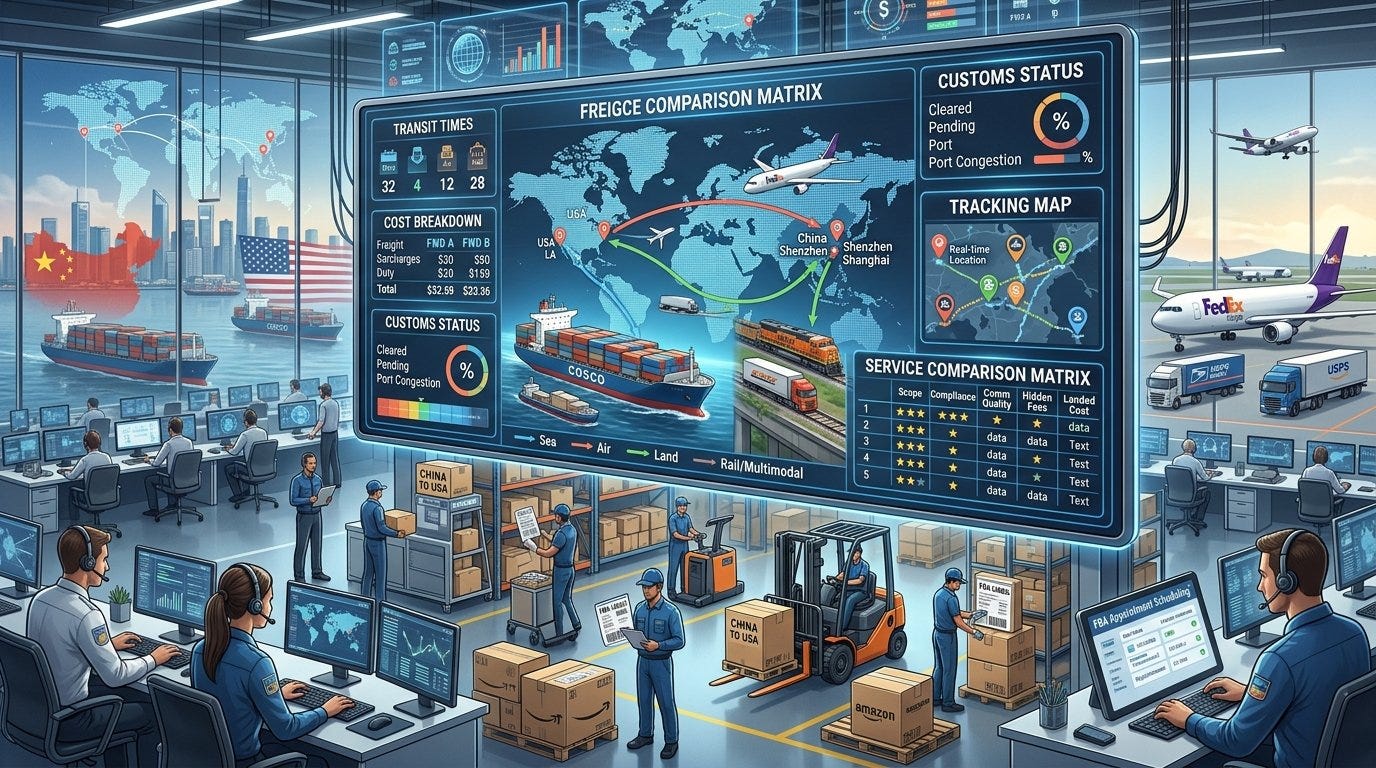
Picking the right freight forwarding services for China to USA shipments isn’t just about finding the lowest price. It’s about matching your business needs with a provider who can actually handle your shipment type, timeline, and destination—without headaches down the road.
A good freight forwarder comparison should focus on service scope, regulatory compliance, communication quality, and the real total landed costs—not just the initial freight quote.
Plenty of importers lose money by choosing shipping from China to USA partners based on price alone. Then they get hit with surprise fees, customs delays, or poor factory coordination once their cargo is already moving.
This guide walks you through what to compare when you’re evaluating logistics companies for your imports. You’ll see which factors really matter for different shipment scenarios, how to spot red flags during the quoting process, and what to ask before you commit to a freight forwarding partner.
Contents hide
2 Core Comparison Criteria for Freight Forwarding Partners
2.1 Evaluating Customs Clearance Expertise and Compliance
2.2 Assessing Transit Times and Tracking Capabilities
2.3 Analyzing Pricing Transparency and Hidden Fees
2.4 Reviewing Warehouse Support and Supply Chain Solutions
3 Service Models and Shipping Methods for China–US Trade
3.1 FCL, LCL, and Consolidation Services
3.2 Comparing Air, Sea, and Express Shipping Options
3.3 Door-to-Door and Amazon FBA Support
3.4 Land, Rail, and Multimodal Logistics
4 Key Players and Logistics Providers to Consider
4.1 Leading International and China-Based Freight Forwarders
4.2 Role of Third-Party Logistics and NVOCCs
4.3 Carrier Relationships and Last-Mile Solutions
6 Cost Structures, Documentation, and Contingency Planning
6.1 Freight Rate Calculations and Chargeable Weights
6.2 Managing Duties, Taxes, and Total Landed Cost
6.3 Navigating Peak Seasons and Port Congestion
6.4 Documentation, Compliance, and Risk Management
7.1 What criteria should I use to compare different forwarding partners for China-to-USA shipments?
RELATED China to USA Freight Forwarders: 2026 Comparison, Costs, and Best Services
Key Takeaways
Don’t compare freight forwarders on price alone—look at service capability, regulatory status, and transparency
Specialized experience matters for Amazon FBA or time-sensitive air freight shipments
Ask about customs handling, excluded fees, and communication before you book
RELATED Freight forwarding from China to USA: How to Choose a China to USA Freight Forwarder?
Core Comparison Criteria for Freight Forwarding Partners
Strong freight forwarders do more than just book cargo space. They manage customs bonds, coordinate warehouses, verify HS codes, and help you avoid hidden fees that eat into your margins.
Evaluating Customs Clearance Expertise and Compliance
Customs clearance often separates reliable freight forwarders from the ones that cause expensive delays. Ask if the provider has an in-house customs brokerage or if they rely on outside partners.
In-house teams usually resolve holds faster. They control your commercial invoice, packing list, and ISF filing—no handoff delays.
Make sure your freight forwarder understands compliance for your specific products. Some goods need USDA, FDA, or other agency reviews before Customs and Border Protection will release your shipment.
Ask for examples of how they handle customs inspections. A good customs broker explains exam types, manages redelivery, and coordinates with CBP so you’re not left clueless.
Check if they can secure customs bonds that fit your import volume. Ship regularly? You’ll want a continuous bond instead of paying for single-entry bonds on every shipment.
See if the provider is registered with the Federal Maritime Commission when acting as an ocean transportation intermediary. That registration protects you under US law when shipping from China to USA.
Assessing Transit Times and Tracking Capabilities
Transit time matters when it affects inventory or sales. Always compare door-to-door transit times, not just the air or ocean leg.
Ask how each provider defines transit time. Some only quote port-to-port, which skips origin pickup, export clearance, import clearance, and final delivery. That can hide days—or weeks—of real lead time.
Request real-time tracking with milestone updates. Basic tracking just says “departed” or “arrived.” Better systems show container pickup, gate-in at port, vessel departure, arrival, customs release, and delivery appointment confirmation.
How do they handle delays? Rollings, blank sailings, port congestion, and customs holds all stretch transit times. The best logistics providers are proactive when exceptions happen.
Try their tracking on a test shipment. Note when you get each update and if it’s accurate. If you only hear about a delay after the fact, their tracking isn’t helping your supply chain.
Analyzing Pricing Transparency and Hidden Fees
Hidden fees can turn a good quote into a nasty surprise. Comparing international freight forwarding companies means looking beyond just the air or ocean freight line.
Ask for a full cost breakdown—origin charges, destination charges, documentation fees, accessorials. Watch for chassis splits, fuel surcharges, terminal handling, and waiting time.
Get a sample invoice from a similar shipment. It shows what “normally” gets billed and exposes fees that never made it into the original quote.
Confirm how demurrage, detention, and per diem charges are calculated. These hit when containers sit too long at terminals or on chassis. Your forwarder should explain free time allowances and help you dodge these costs with better warehouse coordination.
Ask how currency fluctuations and fuel surcharges are handled. Some providers lock rates for 30 or 60 days, others change weekly, which can make budgeting a pain.
Check if cargo insurance is included or optional. Many quotes skip insurance, leaving you exposed if something gets damaged in transit.
Reviewing Warehouse Support and Supply Chain Solutions
Warehouse support gives you more control over inventory once goods reach the USA. If you sell on Amazon, you’ll want a provider with real Amazon FBA support and FBA prep know-how.
Ask if the freight forwarder offers warehousing and distribution. Some just deliver to your address, while others handle short-term storage, cross-docking, and even order fulfillment.
Make sure the warehouse can handle your product type. Hazmat, temperature-sensitive, and oversized goods need special facilities and certifications.
Check their ability to prep shipments for final delivery. Amazon FBA shipments need specific labeling, case packs, and appointments. Mess up any of those and you risk refusals or extra fees.
Ask how they coordinate between customs clearance and warehouse delivery. Delays between customs release and warehouse gate-in just rack up storage costs at container yards.
If you source from multiple countries, review their global supply chain coverage. Consolidating forwarding services and warehousing under one roof can simplify communication and accountability.
RELATED Freight Forwarder China To USA: Essential Guide For Efficient International Shipping
Service Models and Shipping Methods for China–US Trade
Freight forwarders offer a mix of service models and shipping methods depending on your cargo size, urgency, and where it needs to go. The right combo depends on your shipment size, budget, and whether you need factory pickup or Amazon FBA delivery.
FCL, LCL, and Consolidation Services
FCL (Full Container Load) means you rent a whole container for your goods. A 20ft container fits about 28 cubic meters, while a 40ft holds around 58 cubic meters.
This works best if you can fill at least 80% of a container. You pay a flat rate, no matter how much space you actually use inside.
LCL (Less-than-Container Load) lets you share a container with other importers. You pay only for the cubic meters your cargo takes up.
LCL usually costs more per cubic meter than FCL. But for smaller volumes, it can make sense if you don’t have enough for a full container.
Consolidation services combine shipments from multiple suppliers into one container. Many logistics companies handle consolidation at warehouses near big ports like Shenzhen or Shanghai.
This saves money if you’re buying from different factories. It also makes customs clearance easier since you get one shipment, not a bunch of small ones.
Comparing Air, Sea, and Express Shipping Options
Sea freight is the most economical for heavy or bulky cargo. Transit times from China to US ports range from 15 to 35 days, depending on the route and port congestion.
Ocean shipping handles about 90% of China–US trade volume. Rates change with container availability and seasonal demand.
Air freight costs a lot more, but delivers in 3 to 8 days. Carriers charge by actual weight or volumetric weight—whichever’s higher.
It’s a good option for urgent orders, high-value products, or items with short shelf lives. Electronics and fashion often move by air during peak seasons.
Express shipping with DHL, FedEx, or UPS delivers in 2 to 5 days. Express works for samples, documents, or small urgent shipments under 100 kg.
The per-kilo price is highest with express, but built-in customs clearance and door delivery make it easy for smaller businesses.
Door-to-Door and Amazon FBA Support
Door-to-door delivery means the forwarder handles everything—from factory pickup in China to final delivery at your US address. DDP (Delivered Duty Paid) includes customs duties and taxes in the quoted price.
This takes the complexity off your plate, especially if you’re new to logistics. You get one contact and a predictable total cost.
Amazon FBA shipments need special labeling, packaging, and delivery appointment scheduling. Experienced forwarders who know Amazon FBA support requirements prevent rejections at fulfillment centers.
FBA shipments require proper carton labels, pallet specs, and advance booking at Amazon warehouses. Miss any of these and you’ll face delays or extra fees.
Some forwarders offer FBA prep services—labeling, quality inspection, and direct delivery to multiple Amazon facilities across the US.
Land, Rail, and Multimodal Logistics
Rail freight from China to the US is still pretty limited compared to Asia–Europe rail. Most China–US rail means domestic trucking within each country, not direct transcontinental trains.
Road freight (trucking) covers the first and last miles. In China, trucks move containers from factories to ports. In the US, they take goods from ports to your warehouse or address.
Reliable forwarders use their own trucking networks for factory pickups. That helps avoid delays from suppliers missing container loading deadlines.
Multimodal logistics mixes different shipping methods in one journey. A common example: truck from a Chinese factory to port, ocean freight to LA, then rail or truck to your US warehouse.
Experienced forwarders design multimodal solutions to balance cost and speed. They also coordinate between carriers and transport modes so you don’t have to.
RELATED Ultimate Guide: Finding the Best Freight Forwarder from China to the USA
Key Players and Logistics Providers to Consider
U.S. importers have several options for logistics providers when shipping from China. Large international forwarders, China-based specialists, NVOCCs, and carriers each offer different strengths, depending on your shipping volume, service needs, and delivery requirements.
Leading International and China-Based Freight Forwarders
Large global providers like DHL Global Forwarding, Kuehne + Nagel, and Expeditors International run massive networks and have strong carrier relationships. These companies handle a ton of volume and keep things pretty standardized.
They’re a good fit for enterprises with steady shipping patterns and their own logistics teams. If you need scale and predictability, these big names usually deliver.
Sinotrans, one of China’s biggest state-owned logistics companies, brings deep know-how in export procedures and factory coordination. This sort of China-based freight forwarder often offers sharper origin costs and smoother communication with suppliers.
Digital platforms like Flexport blend tech with traditional forwarding. Their online dashboards and easy booking tools appeal to mid-sized importers who want more control and transparency.
Smaller specialists such as AEB Logistics and DocShipper focus on China-to-USA lanes. These providers usually give more personalized service and faster replies than the giants.
When you’re evaluating anyone, check their FMC registration for ocean shipments. Ask about their experience with your type of cargo—details matter.
Role of Third-Party Logistics and NVOCCs
NVOCCs (Non-Vessel Operating Common Carriers) issue their own bills of lading and consolidate cargo from multiple shippers. They have to register with the Federal Maritime Commission, so there’s some regulatory oversight and basic financial protection for you.
Third-party logistics providers (3PLs) do more than just freight forwarding. They might handle warehousing, order fulfillment, and inventory across locations.
This gets valuable if you need warehouse capabilities tied in with your shipping schedule. Some NVOCCs even run their own consolidation warehouses in major Chinese port cities, which lets them offer competitive LCL rates and flexible departures.
Ask your potential provider if they handle cargo consolidation themselves or use intermediaries. It can affect both cost and control.
Carrier Relationships and Last-Mile Solutions
Direct carriers like UPS, FedEx, and DHL manage both international transport and final delivery in the US. They’re great for time-sensitive shipments and offer integrated tracking, but their door-to-door rates tend to be higher than using a forwarder with bulk contracts.
Freight forwarders with solid carrier relationships can grab better container space during peak times. They also get priority when equipment’s tight.
You should ask how long a forwarder has worked with particular ocean lines or airlines. Those connections can make a real difference.
Last-mile delivery is crucial for Amazon FBA support, where delivery windows are strict. Forwarders with FBA experience coordinate with Amazon fulfillment centers and know all the labeling rules.
They set up delivery appointments and double-check that pallets meet Amazon’s specs before anything leaves China. It’s a level of detail you don’t want to skip.
RELATED Top Tips to Find the Best Freight Forwarder China to USA
About AEB Logistics
AEB Logistics is a China-based freight forwarder specializing in shipping from China to USA. The company runs offices in major Chinese manufacturing and port regions, giving them direct access to factories and export hubs.
They’re FMC licensed and hold NVOCC registration for ocean freight. That means they can legally arrange container shipping and issue their own bills of lading.
Core services include:
Ocean freight (FCL and LCL)
Air freight and express shipping
Door-to-door delivery with DDP terms
Customs brokerage and clearance
Amazon FBA prep and delivery
AEB Logistics provides transparent pricing with itemized quotes that break down origin charges, ocean freight, destination fees, and customs costs. You see what you’re paying for before you commit.
The team handles ISF filing, HS code classification, and Section 301 tariff compliance for US-bound imports. They keep licensed customs brokers on staff to file formal entries with US Customs and Border Protection.
For ecommerce sellers, AEB Logistics coordinates Amazon FBA shipments with labeling, carton prep, and direct delivery to Amazon warehouses. They track shipments from pickup in China through final delivery at your warehouse or fulfillment center.
Cost Structures, Documentation, and Contingency Planning
Freight costs go way beyond just the base ocean rate. How forwarders calculate charges, handle compliance, and react to disruptions can really impact your bottom line and delivery reliability.
Freight Rate Calculations and Chargeable Weights
Your forwarder should explain how they calculate chargeable weight, since that’s what you’ll pay. Ocean freight charges by CBM (cubic meter), while air freight uses whichever is higher: actual weight or volumetric weight (length × width × height ÷ 6,000 for air).
If your forwarder helps you optimize packaging density, you can cut billable volume. Always ask for itemized quotes that separate ocean freight, fuel surcharges, CFS fees, and destination charges.
Fuel surcharges change monthly with bunker prices and can tack on 15-30% to base rates. Compare at least two or three providers with transparent pricing to dodge hidden fees at destination.
Ask if freight forwarding services include terminal handling, documentation, and customs filing. Some bundle these, others split them out, so you need a full cost breakdown to compare apples to apples.
Managing Duties, Taxes, and Total Landed Cost
Total landed cost covers freight, duties, taxes, insurance, and handling. Your forwarder should help you forecast this before you sign with a supplier.
Understanding Incoterms—especially FOB (Free on Board)—makes it clear when ownership and cost responsibility move from seller to buyer. Work with a forwarder who knows HS code classification and tariff engineering.
Misclassification can cause penalties or shipment delays. A savvy provider finds duty-saving moves using programs like Section 321 (de minimis) or First Sale rules.
When shipping from China to USA, tariffs might be anywhere from 0% to over 25% depending on your product and current policy. Your forwarder should keep an eye on regulatory changes and adjust landed cost models as needed, especially when trade policy gets shaky.
Navigating Peak Seasons and Port Congestion
Peak seasons—usually July through October for holiday inventory—push up rates and shrink available space. Find out if your forwarder offers contract rates or priority booking when things get busy.
Spot rates can double during crunches. Port congestion on the West Coast or weather delays mean you need a backup plan.
Ask how quickly your forwarder can reroute shipments or switch carriers. Providers with strong carrier ties can still get space even when it’s tight.
For Amazon FBA shipments, late arrivals in Q4 can kill your revenue. Pick a forwarder who builds buffer time into schedules and tells you about delays before they mess with your inventory planning.
Documentation, Compliance, and Risk Management
Accurate paperwork—commercial invoice, packing list, bills of lading, and ISF filing—keeps customs holds at bay. Your forwarder should double-check that carton labeling meets Amazon FBA requirements, like FNSKU labels and suffocation warnings, before shipping from China.
Customs clearance expertise really matters. A good forwarder files ISF 10+2 at least 24 hours before vessel departure and handles AMS and entry filings with US Customs and Border Protection.
They should manage FDA, CPSC, or other regulatory needs for your product, too. Risk management means cargo insurance, compliance audits, and backup carriers.
Ask if your provider offers All Risk marine insurance and how they handle damaged or missing goods. Solid Amazon FBA support includes prep services, inspections, and repacking to cut down on chargebacks from receiving centers.
RELATED Freight Forwarding China to USA: Best China to USA Freight Forwarders for New Importers
Frequently Asked Questions
Comparing freight forwarders isn’t just about price. Check licenses, tracking records, customs skills, and warehouse systems. The right questions help you spot who handles paperwork right, delivers on time, and gets your fulfillment needs.
What criteria should I use to compare different forwarding partners for China-to-USA shipments?
Start by checking that each provider has a valid freight forwarder license and customs broker bond. Licensed forwarders have to register with the Federal Maritime Commission for ocean freight or operate as indirect air carriers for air.
Look at their network coverage in both China and the US. You want partners with offices or agents close to your suppliers and near your US delivery points.
Ask for references from clients with similar cargo and volume. A forwarder that’s great with full containers might not be the best for small parcel consolidation or temperature-sensitive goods.
Compare their tech platforms for booking, docs, and tracking. Digital systems give you real-time visibility and faster answers than old-school phone-and-email setups.
Check out their carrier relationships and contract rates. Freight forwarders with strong partnerships can get better pricing and space during peak times.
How can I verify whether a provider has reliable customs brokerage and compliance support for U.S. entry?
Ask if the forwarder has licensed customs brokers in-house or uses third-party brokers. In-house teams usually respond faster to CBP holds and document requests.
Request their process for HTS code classification and duty calculation. Accurate classification saves you from expensive reclassifications and delays at the port.
Find out if they monitor regulatory changes that could affect your products. Providers with strong compliance teams track Section 301 tariffs, FDA rules, and other agency requirements before your shipments land.
Test their response time by asking specific questions about your products. Reliable brokers answer customs questions within hours—not days—and give you written guidance you can refer to later.
Which service-level metrics best predict on-time delivery and consistent transit times on the China–U.S. lane?
On-time delivery rate shows what percentage of shipments arrive within the promised window. The top forwarders usually hit 95% or higher for ocean freight and 98% for air shipments.
Average transit time isn’t as important as consistency. A forwarder who always delivers ocean shipments in 18-20 days is better than one who sometimes takes 14 days and sometimes 28.
Ask for data on customs clearance speed. Shipping from China to USA needs smooth customs processing, so find out how many of their shipments clear CBP within 24 hours of arrival.
Check their detention and demurrage rates. If fees are high, that usually means poor coordination between ocean arrival, customs clearance, and final delivery pickup.
Ask about their backup plans when things go wrong. Forwarders with several carrier options and flexible routing can rebook your cargo quickly if vessels get delayed or canceled. Not all forwarders have that kind of agility, frankly.
What documents and data should a forwarder manage to reduce clearance delays and unexpected fees?
Your forwarder needs to handle the Importer Security Filing at least 24 hours before vessel departure. Late ISF filings get you an automatic $5,000 penalty per shipment, which is just painful.
They should prepare commercial invoices with clear product descriptions, correct HTS codes, and accurate declared values. If the descriptions are vague or the codes are wrong, CBP will probably hold your shipment for review.
Ask them to check that all documents match before filing. If your invoice, packing list, and bill of lading don’t line up, it creates red flags and slows clearance.
The forwarder should track certificates of origin, compliance permits, and agency approvals for regulated products. If you’re missing FDA, FCC, or other required certificates, your goods will get stuck at the border.
Ask how they handle duty payment and bond coverage. Some forwarders front duties through continuous bonds, while others want you to pay before release. That can affect your cash flow more than you’d expect.
How do I assess a provider’s warehouse options, including consolidation, labeling, and inventory handling before export and after arrival?
Visit or ask for detailed info about their China-side warehouse locations. Warehouses close to your suppliers can cut domestic trucking costs and speed up export processing.
See if they offer consolidation services that combine shipments from multiple suppliers into one container. Logistics companies comparison suggests consolidation can slash ocean freight costs by 30-50% compared to shipping small quantities separately.
Ask about their USA warehouse capabilities for deconsolidation, storage, and final-mile delivery. Having warehouse space in the US gives you more flexibility when retail delivery windows shift or you need to split containers across multiple destinations.
Request their quality control and inspection procedures. Good forwarders check carton counts, verify product labeling, and document damage before cargo leaves China—it’s just a smart move.
Make sure they can handle any special labeling, repackaging, or kitting your products need. Some warehouses only do basic palletizing, while others offer full value-added services like retail compliance labeling and display assembly. Not every provider goes the extra mile here, so it’s worth asking.
What capabilities should I look for to ensure smooth deliveries into Amazon fulfillment centers, including appointment booking and packaging requirements?
Your forwarder really needs to know Amazon’s strict receiving and packaging rules. Every fulfillment center has its own box labeling, pallet stacking, and appointment scheduling requirements, and breaking those rules can get your shipment rejected.
See if they offer FBA prep services like FNSKU labeling, poly-bagging, bubble wrapping, and case pack configuration. These steps have to be done before your shipment shows up at the fulfillment center—no shortcuts here.
Ask about their approach to booking appointments at Amazon warehouses. The best providers keep an eye on delivery windows, schedule appointments automatically, and reschedule quickly if Amazon changes up the receiving times (which, honestly, happens more than you’d expect).
Make sure they can deliver to multiple fulfillment centers from a single consolidated shipment. Amazon FBA support often means splitting containers and coordinating deliveries across different states, which isn’t always simple.
Find out how they handle Amazon fee disputes and chargebacks. Experienced FBA forwarders document every step with photos and delivery receipts, so they can push back against unfair receiving fees or rejection claims if needed.
Related Posts
China to USA Freight Forwarders: 2026 Comparison, Costs, and Best Services
Freight forwarding from China to USA: How to Choose a China to USA Freight Forwarder?
Freight Forwarder China To USA: Essential Guide For Efficient International Shipping
Ultimate Guide: Finding the Best Freight Forwarder from China to the USA