

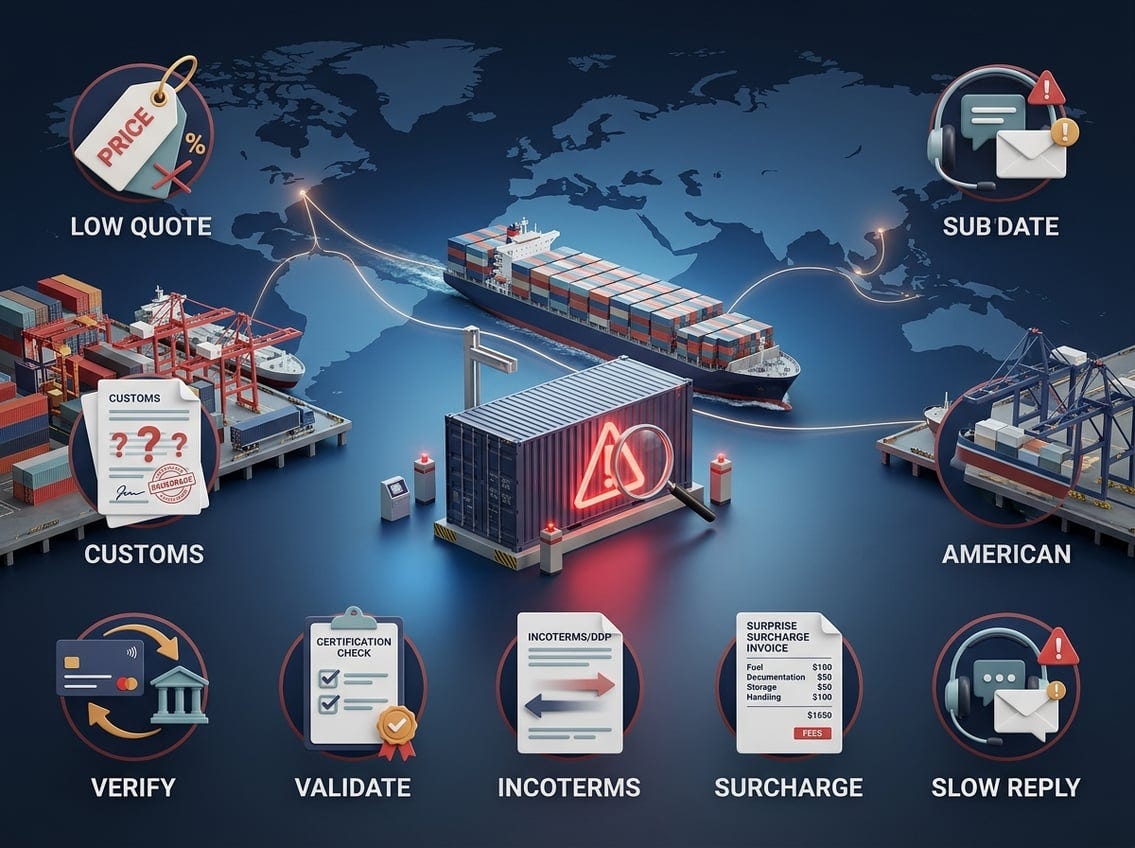
Freight forwarding keeps goods moving from China to the USA. If you run a small business, you probably rely on a forwarder for customs, shipping, and delivery.
But, let’s be honest—not every freight forwarder brings the same honesty or service. Some cut corners on pricing, communication, or customs support, and that can mean delays, hidden fees, or even lost shipments.
Spotting the warning signs of an unreliable freight forwarder can save your business from a lot of headaches and keep your supply chain from grinding to a halt.
Contents hide
1 Unusually Low Quotes That Exclude Key Fees
2 Unclear Customs Brokerage and Import Responsibilities
3 Requests for Payment to Personal or Unverifiable Accounts
4 No Verifiable FMC, NVOCC, or US Customs Credentials
5 Vague Incoterms and Ambiguous DDP Promises
6 Hidden Surcharges for Fuel, Documentation, Storage, or Handling
7 Poor Communication and Slow Responses Before Booking
8 Building a Reliable Import Process
8.1 Documentation and Customs Readiness
8.2 Communication Standards for Shipment Updates
9 Protecting Costs and Delivery Performance
9.1 How to Compare Total Landed Costs
9.2 Shipment Visibility and Supply Chain Planning
10.1 What warning signs suggest that a shipping provider’s quote may include hidden fees?
10.2 How can importers verify whether a provider has experience with China-to-USA shipments?
10.3 What level of shipment tracking and visibility should a reliable provider offer?
10.4 Why is clear communication important when choosing a provider for overseas cargo?
10.5 How can a provider’s customs support affect delivery timelines and unexpected costs?
10.6 What should small businesses compare when evaluating multiple shipping quotes?
RELATED Freight forwarding from China to USA: How to Choose a China to USA Freight Forwarder?
Unusually Low Quotes That Exclude Key Fees
A quote that seems too cheap? It usually is. Some freight forwarders dangle a low base rate, then tack on extra fees that weren’t mentioned at the start.
This sneaky move can push your total shipping cost way past what you budgeted. Watch out for quotes that skip over things like customs exam fees, demurrage, detention, or destination accessorials.
Those extra charges pile up fast once your shipment hits the USA. A forwarder you can trust lists these fees, even if they don’t always apply.
Ask about duty assumptions, too. Some forwarders bake in a duty rate that’s lower than what you’ll actually owe, leaving you with a surprise bill later. That’s just one of the hidden fees that can sneak into sketchy DDP quotes.
Before you jump on any offer, compare it to other quotes for the same route and cargo. If one price is way lower, ask why. A cheap quote often hides missing charges or weak carrier options that end up costing you more in the long run.
RELATED Freight Forwarder China To USA: Essential Guide For Efficient International Shipping
Unclear Customs Brokerage and Import Responsibilities
A reliable freight forwarder spells out exactly who handles customs clearance and what you owe. If a company dodges questions about broker fees or duty payments, that’s a red flag.
Some forwarders bundle brokerage costs into vague line items. Others leave you guessing about who files your entry summary or pays duties on time.
This confusion can lead to costly customs delays and penalties—and you could be on the hook. Ask your forwarder for the name of the licensed customs broker handling your stuff.
Get it in writing: who submits import documents to CBP? Customs enforcement has gotten stricter, and federal agencies have even set up a task force to target duty evasion and trade fraud.
Your forwarder should flag documentation issues before your cargo arrives. Missing forms or wrong codes can trigger holds, and knowing the common causes of customs holds helps you sidestep them.
If a forwarder can’t explain these roles clearly, move on. Clear answers protect your shipment and your budget.
Requests for Payment to Personal or Unverifiable Accounts
A trustworthy freight forwarder always asks for payment to a verified business account. If someone asks you to send money to a personal bank account, that’s a huge red flag.
Legitimate forwarders in China use registered business accounts, not personal ones. When someone wants payment outside the usual business channels, they’re probably pulling a scam. It’s not rare; payment fraud often involves requests for wire transfers or personal accounts instead of legit business accounts.
Before you pay, check that the account name matches the company’s official name. Ask for a business license and make sure the bank details line up with the company’s registration.
If a forwarder tries to rush you or skips these checks, slow things down. Take the time to verify every detail, even if it means your shipment leaves a day later.
RELATED Ultimate Guide: Finding the Best Freight Forwarder from China to the USA
No Verifiable FMC, NVOCC, or US Customs Credentials
Any freight forwarder handling ocean shipments to the US needs the right licenses. That means registration with the Federal Maritime Commission, which oversees international ocean transportation.
If a forwarder can’t show you a valid license number or refuses to share it, that’s a warning sign. You can look up a company’s status with the FMC’s public OTI list, which shows who’s currently registered.
Some companies claim NVOCC status but skip steps like filing a tariff. The FMC keeps a list of non-compliant NVOCCs who haven’t met the rules. Being on this list means they’re risking their license.
You can also check the CBP NVOCC public list to see who’s authorized to move cargo through US Customs. Working with an unlicensed or non-compliant company puts your shipment at risk—delays, fines, even seized cargo. Picking a properly licensed logistics partner protects your business from all that mess.
RELATED Top 7 Freight Forwarders from China to USA: A Comprehensive Guide for International Shipping
Vague Incoterms and Ambiguous DDP Promises
If a freight forwarder throws around “DDP” without details, ask more questions. DDP means Delivered Duty Paid, but only if the forwarder lays out who pays duties, taxes, and customs fees.
If your quote just says “DDP” with no breakdown, you could get hit with surprise costs. Some forwarders use DDP as a selling point but never explain what it really covers. That’s one of the big hidden risks in DDP deals from Chinese forwarders.
A solid forwarder will walk you through the whole DDP shipping process from China to the USA, outlining which fees are included and which aren’t. They’ll also compare DDP to other Incoterms, since understanding Incoterms in plain English helps you know what you’re paying for.
If a forwarder can’t give you a clear DDP definition, take it as a warning. Get a written breakdown before you agree to ship anything.
RELATED Freight Shipping from China to USA: Methods, Costs & Key Steps
Hidden Surcharges for Fuel, Documentation, Storage, or Handling
Low base rates often hide extra fees that pop up later. Watch for hidden shipping charges from China to the USA covering customs clearance, port handling, warehousing, and fuel surcharges.
Fuel surcharges change all the time and can bump up your final bill. Ask your forwarder how these charges work and how often they update them.
Documentation fees are another common add-on. Some forwarders bill separately for paperwork tied to export and import customs clearance, even though it should be part of the base service.
Storage fees can pile up quick if your cargo sits at a port or warehouse. You might face charges for chassis usage, port congestion, or demurrage and detention after your free days run out.
Handling fees also sneak in. Ask for a full breakdown—terminal handling, container fees, any other charges for moving your goods at each stage. If a forwarder dodges this, that’s your cue to look elsewhere.
RELATED Freight Forwarder in China: Comprehensive Shipping & Logistics Guide
Poor Communication and Slow Responses Before Booking
Before you book anything, pay attention to how a freight forwarder communicates. If they take days to answer simple questions, that’s often a sign of bigger problems once your cargo is moving.
Quick, clear responses during the sales process usually mean you’ll get the same service later. If a forwarder is tough to reach before you sign a contract, don’t expect things to magically improve after you pay—this is a common red flag when choosing a freight forwarder.
Watch for vague or confusing answers about shipping terms. If instructions about your shipping method seem unclear or even a bit contradictory, that’s a warning sign, according to red flags with Chinese freight forwarders.
Language barriers can slow things down, too. Many China-based forwarders mainly use Mandarin, which can cause delays or mix-ups for international clients—see this guide on challenges working with a freight forwarder in China.
Ask yourself if the forwarder answers questions directly or just dodges them. Reliable partners give straight answers, even when the news isn’t great.
RELATED Explore how to choose the right freight forwarder China to USA
Building a Reliable Import Process
A solid import process really hangs on two things: paperwork that matches what customs wants, and clear updates about where your goods are at every step.
When you nail both, you avoid delays, surprise fees, and shipments getting stuck somewhere.
Documentation and Customs Readiness
Your paperwork needs to be correct before your goods even leave China. Missing or wrong documents are a top reason shipments get held at the border.
At minimum, you should have these documents for every shipment:
Commercial invoice with accurate product descriptions and values
Packing list matching the invoice
Bill of lading or airway bill
Correct HS codes for duty calculation
Certificate of origin, if your product category needs it
Ask your forwarder how they check HS codes before filing. Wrong codes mean wrong duty payments, and customs enforcement in 2026 is stricter than ever, so mistakes are more likely to get flagged.
A reliable forwarder reviews your documents ahead of time and points out problems before your cargo ships.
Communication Standards for Shipment Updates
You shouldn’t have to chase down info about your shipment. Set clear expectations with your forwarder about how often they’ll send updates and through what channel—maybe that’s email, a portal, or a shared tracking link.
A dependable forwarder gives you updates at key milestones: booking, departure, transit, arrival, and customs clearance.
If you go more than a few days without news during an active shipment, something’s off. Ask upfront how they handle delays or customs problems. Will they call you right away, or do you only find out weeks later?
Clear, proactive communication is usually what sets a good forwarder apart from one that leaves you wondering—especially when you hit red flag situations.
RELATED Freight forwarding from China to USA: How to Choose a China to USA Freight Forwarder?
Protecting Costs and Delivery Performance
Your bottom line isn’t just about the freight rate you see on a quote. You also need to know the total cost of getting goods from a factory in China to your warehouse, and whether you can track that shipment the whole way.
How to Compare Total Landed Costs
Low freight quotes often hide fees that pop up later. To compare forwarders fairly, ask for a full cost breakdown before you sign anything.
Your landed cost should include:
Ocean or air freight charges
Customs duties and tariffs, which have gotten more complicated under current rules (see this customs clearance guide)
Port and terminal handling fees
Trucking or last-mile delivery
Insurance
Documentation and customs brokerage fees
Ask each forwarder for the same shipment details, then get a line-item quote. This lets you compare forwarders side by side instead of just headline prices.
If a forwarder won’t break out the costs, that’s a red flag.
Shipment Visibility and Supply Chain Planning
You need to know where your goods are—not just when they leave port or show up at your door. Real-time tracking helps you plan inventory, alert customers about delays, and spot problems early.
Ask any forwarder you’re considering:
Do you provide online tracking with regular status updates?
Who do I contact if a shipment is delayed or stuck at customs?
How do you notify me about problems?
A reliable forwarder gives you visibility at each step: pickup, port loading, transit, customs clearance, and final delivery.
If you don’t get this, you’re left guessing when goods will arrive, which makes it tough to manage reorders or hit deadlines.
RELATED Freight Forwarder China To USA: Essential Guide For Efficient International Shipping
Frequently Asked Questions
Before you sign a contract with a freight forwarder, get clear answers about pricing, credentials, tracking, and customs support. These questions cover the most common issues you’ll run into when checking out providers for China to USA shipping.
What warning signs suggest that a shipping provider’s quote may include hidden fees?
If a quote looks too good to be true, it probably is. Watch for prices that skip specific line items like fuel surcharges, customs clearance, or destination handling fees.
If a provider won’t break down costs when you ask, that’s a problem. Be careful if the quote leaves out duties and taxes without explaining who’s responsible.
Legit providers give you an itemized breakdown upfront. That way, you can compare freight forwarder options without guessing about hidden add-ons.
How can importers verify whether a provider has experience with China-to-USA shipments?
Ask for proof of active licenses. A real forwarder should hold a Federal Maritime Commission (FMC) license if they operate as an NVOCC, and you can check this in the FMC’s public database.
You should also ask for references from other small business clients who ship similar goods. Someone with real experience can name specific ports they use and talk about common customs issues for your product.
If they can’t answer basic questions about tariffs or export control red flags, that’s a sign to keep looking.
What level of shipment tracking and visibility should a reliable provider offer?
Expect real-time updates at each big milestone: pickup, departure from the origin port, transit, and arrival at the destination port.
Most established providers offer online portals or apps so you can check status without chasing someone down. If a provider only gives updates when you ask, or if tracking is vague and infrequent, it’s hard to plan around delays.
Why is clear communication important when choosing a provider for overseas cargo?
Shipping delays and customs issues happen, and how your provider communicates in those moments really matters. You need someone who responds quickly and gives you straight answers, not just vague reassurances.
Poor communication early on usually means bigger headaches later. If they’re slow to answer basic questions before you’ve signed a contract, expect that to continue once your cargo’s in transit.
How can a provider’s customs support affect delivery timelines and unexpected costs?
Customs clearance is one of the most common places shipments get delayed. A provider who knows documentation requirements, tariff codes, and Incoterms can help you avoid expensive holds at the border.
If your provider gives fuzzy answers about who handles customs brokerage or who’s responsible for import duties, that’s risky. Confusion here can mean storage fees, penalties, or shipments stuck at port while paperwork gets sorted out.
Also, ask how the provider handles Delivered Duty Paid (DDP) terms. Vague DDP promises without clear terms often mean unclear responsibility for duties and fees.
What should small businesses compare when evaluating multiple shipping quotes?
Don’t just fixate on the price tag. Take a close look at transit times and the services each quote includes.
Does the provider offer customs support? What’s their process if your shipment runs late or gets damaged?
It’s smart to see how each company wants you to pay. If someone asks you to send money to a personal bank account, that’s usually a big red flag—probably best to walk away.
Double-check that Incoterms are spelled out in every quote. These terms show you exactly when responsibility for the shipment shifts from the forwarder to you, which can change your costs and risks.
Related Posts
Freight forwarding from China to USA: How to Choose a China to USA Freight Forwarder?
Freight Forwarder China To USA: Essential Guide For Efficient International Shipping
Ultimate Guide: Finding the Best Freight Forwarder from China to the USA
Top 7 Freight Forwarders from China to USA: A Comprehensive Guide for International Shipping